
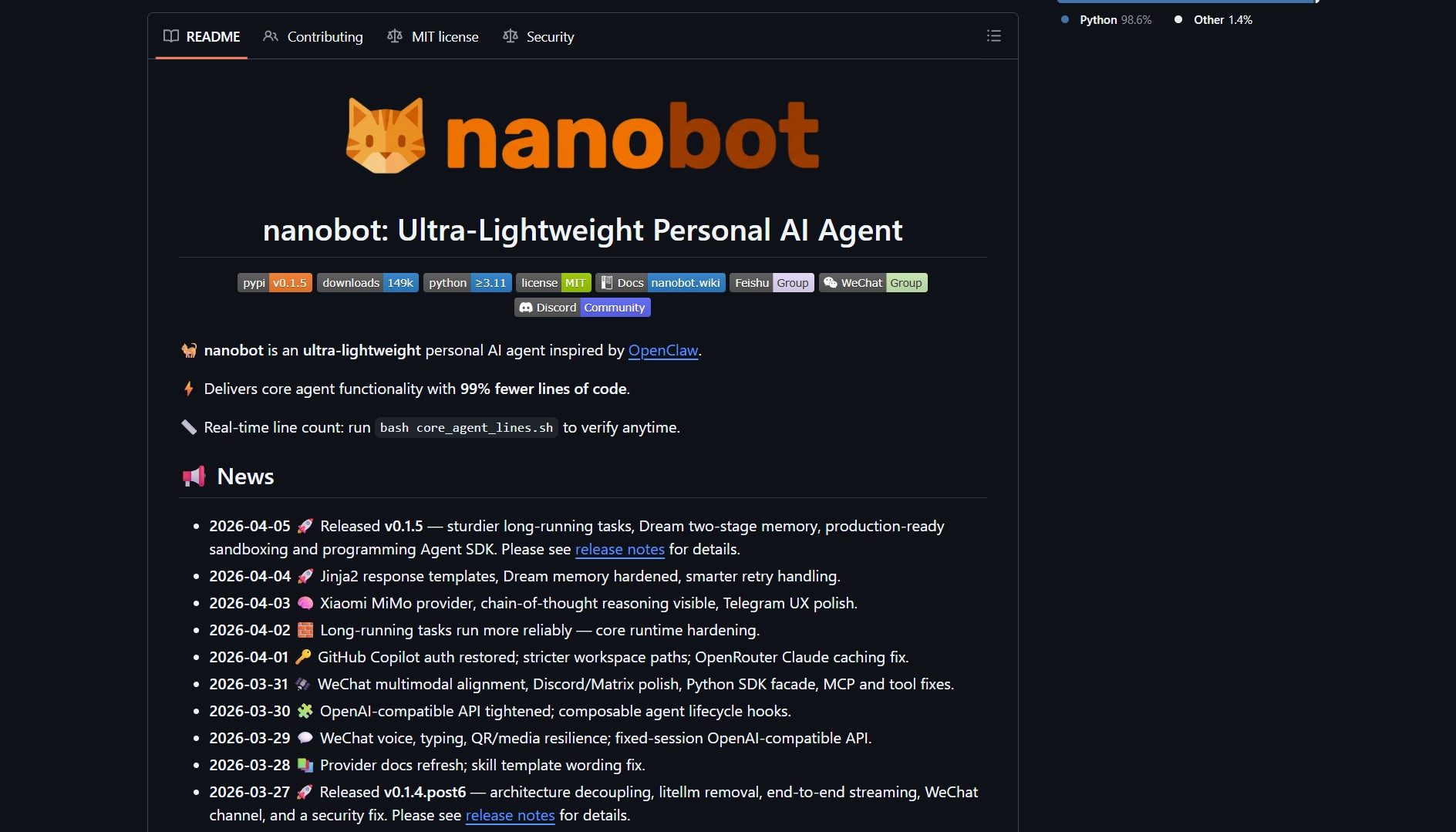
I ran into this repo on GitHub and had to stop, because Nanobot is an ultra-light Clawdbot-style assistant that boots in under a minute. Where Clawdbot requires 430,000 plus lines of code to run, Nanobot delivers the same core agent loop in roughly 4,000 lines, which is a dramatic reduction in complexity and surface area.
Nanobot is a minimal, research-friendly agent framework from HKUDS that focuses on readability, speed, and low resource usage. The repository demonstrates a compact core agent loop, real-time tooling to count lines (core_agent_lines.sh), and ergonomics that make the codebase approachable for researchers and engineers.
Customer Persona
The typical Nanobot user is a machine learning researcher or software engineer who needs a lightweight, inspectable agent framework for prototyping AI behaviors. They value code readability, fast iteration cycles, and minimal dependencies over production-ready safety features. This persona often works in academic or R&D environments where they need to experiment with agent loops without the overhead of larger frameworks like LangChain or AutoGPT.
Market Analysis
Nanobot enters a crowded market of AI agent frameworks, competing with heavyweights like LangChain, AutoGPT, and Clawdbot. Its differentiation lies in its extreme minimalism—4,000 lines versus 430,000—making it uniquely suited for research and educational use. While it lacks the battle-tested robustness and ecosystem of larger frameworks, its small size allows for full auditability and customization. For production deployments, teams would likely still choose more mature options, but Nanobot fills a niche for rapid prototyping and agent architecture studies. For connecting AI agents to external services, consider using techniques shown in our guide on connecting AI agents to Google Workspace.
Project Link
Project link:
https://github.com/HKUDS/nanobot
How It Works
At a high level, Nanobot implements the standard agent loop with tight, explicit components, and a small set of adapters for tools and IO. The project emphasizes compact state encodings and a minimal runtime so you can reason about behavior in a single afternoon.
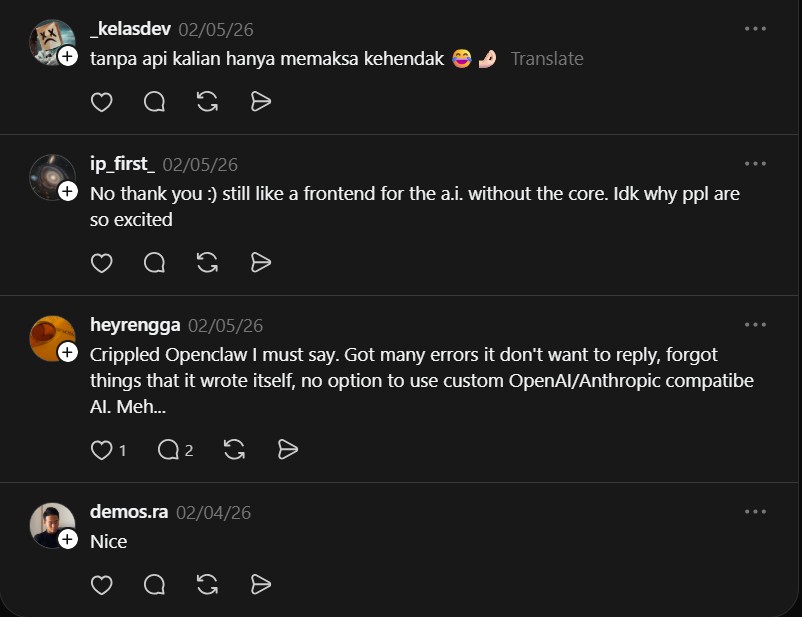
Integration starts by cloning the repository and inspecting the line count with the included script. For production deployments, you may want to consider more robust frameworks like Gobii for durable autonomous agents. The README provides step‑by‑step instructions for running the agent and connecting to your preferred LLM. Testing with a non‑critical workload is recommended to ensure behavior matches expectations.
| Feature | Why it matters |
|---|---|
| Ultra-Lightweight, small codebase that starts fast and is easy to inspect | Reduces maintenance overhead and attack surface, ideal for research and prototyping |
| Research-Ready, readable structure makes experimentation straightforward | Enables rapid iteration and customization without navigating complex abstractions |
| Lightning Fast startup, no massive dependency load, quick iterations | Lets you test agent behaviors in seconds, not minutes |
| One-click deploy, minimal setup to get the agent loop running | Lowers the barrier to entry for developers new to agent frameworks |
Line count comparisons are indicative, not a full measure of capability. A smaller codebase reduces maintenance overhead and attack surface, but you should validate features and stability for your use case.
Advertising Section
For more advanced AI agent deployments, explore our partner solutions.
The Verdict
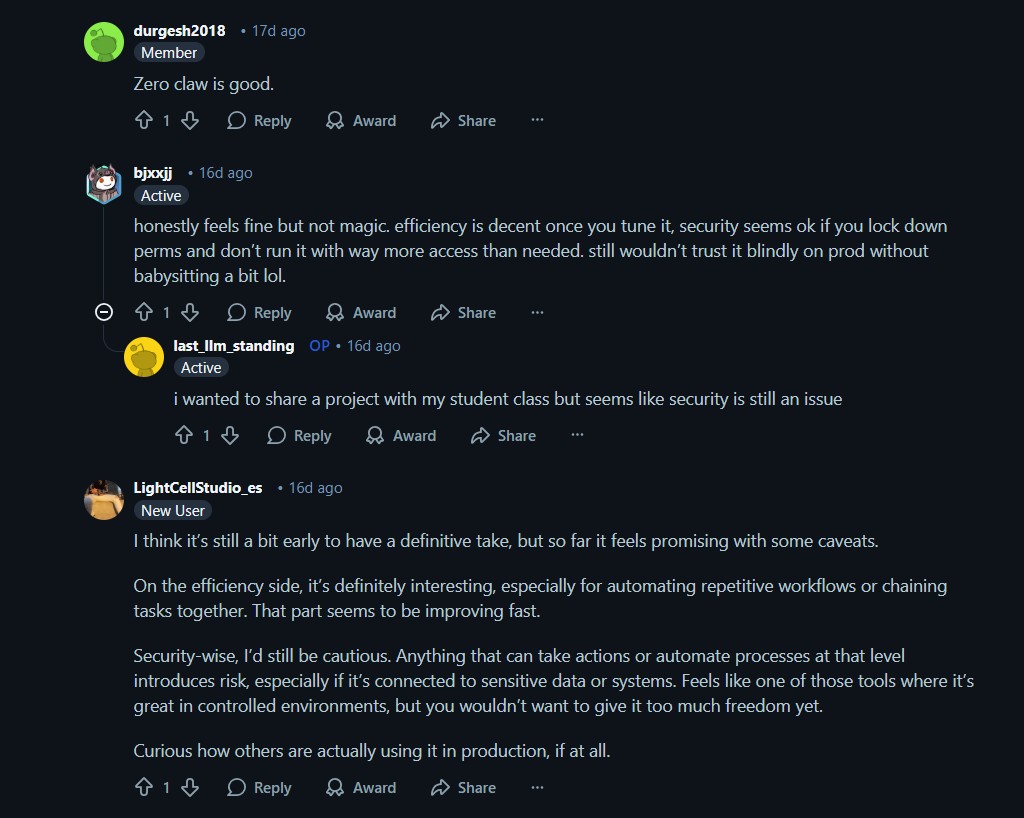
Nanobot delivers an ultra-light personal AI agent with minimal code footprint. The dramatic reduction in lines—from 430,000 to 4,000—provides inspectability and speed that is great for research and prototyping. However, minimal frameworks may omit hardened defaults or safety guards you expect in larger stacks. Do not run on sensitive systems without appropriate sandboxing and access controls. If you adopt Nanobot for anything beyond experimentation, build a safety layer, add monitoring, and validate behavior under representative workloads.