
Gobii is an open-source platform for running durable autonomous agents in production. It solves the problem of unreliable, ephemeral AI agents by providing persistent, always-on agents that survive restarts and can be contacted like coworkers. Each agent runs continuously, wakes from schedules and events, uses real browsers, calls external systems, and coordinates with other agents.
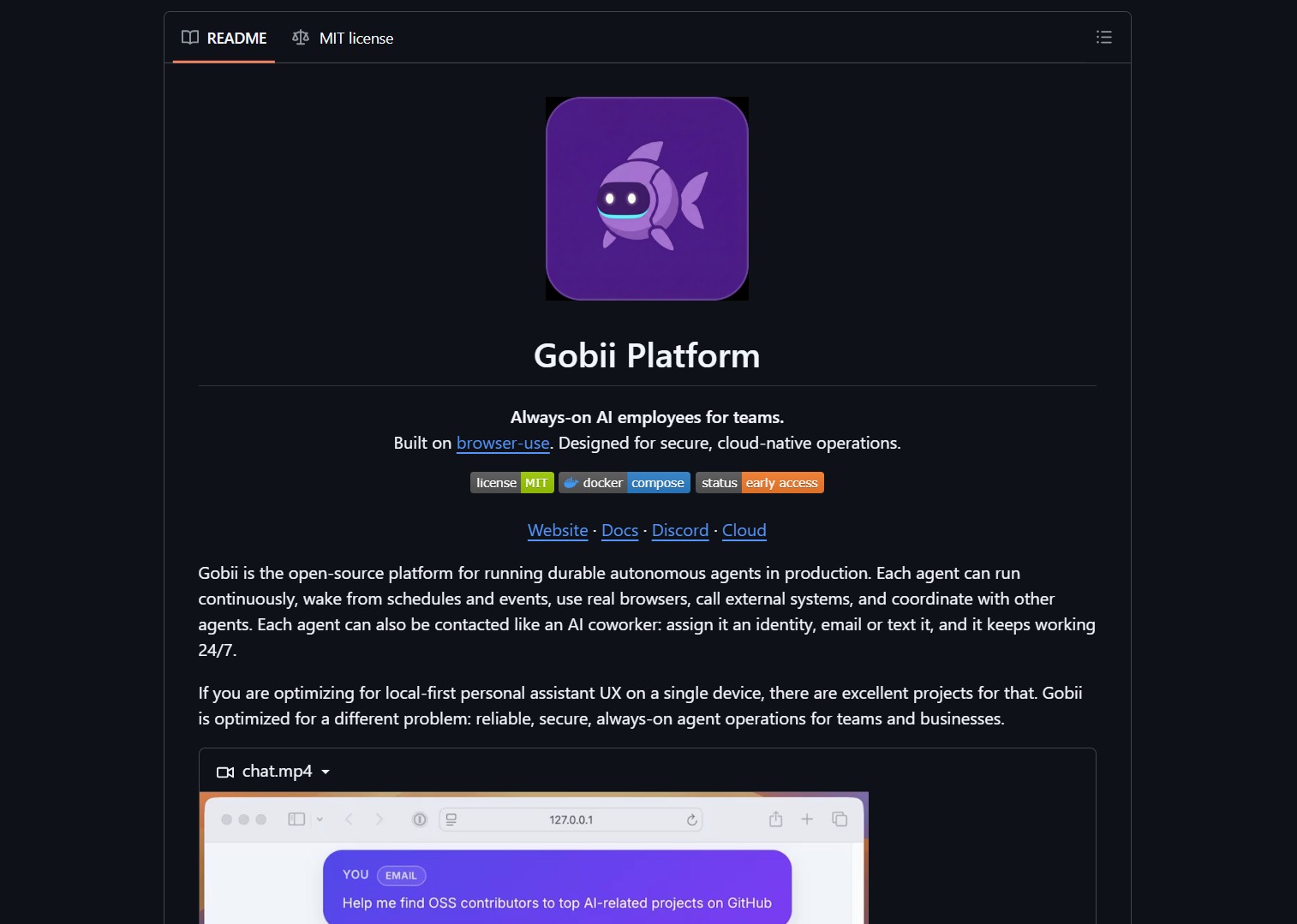
Gobii targets teams and businesses needing reliable agent operations. It bundles scheduling, communication, persistence, coordination, and browser automation into a cohesive platform. Agents become first-class citizens with durability, email and text accessibility, and real browser capabilities built-in.
Project Repository
Project link:
https://github.com/gobii-ai/gobii-platform
How to Deploy & How It Works
Gobii is built for production deployment with a modular architecture. The platform handles agent state persistence, event-driven scheduling, and multi-agent coordination. Agents can be triggered via schedules, external events, email, or text messages.
- Clone the repository with git clone https://github.com/gobii-ai/gobii-platform.git.
- Explore the documentation in the README.md file for setup instructions.
- Configure agent definitions using the built-in YAML syntax for durability, contactability, and capabilities.
- Deploy agents as persistent services that survive system restarts and failures.
- Monitor agent activity through the platform’s logging and coordination features.
The platform’s design contrasts with typical agent frameworks that treat agents as disposable functions. Unlike single-session chatbots or local assistants, Gobii agents are durable services. This approach mirrors the architectural patterns seen in Claw Code where persistence and coordination are core features.
The Verdict / The Catch
Gobii excels at production-grade autonomous agent workflows. It delivers reliable, always-on agents with built-in scheduling, communication channels, and browser automation. The platform is ideal for teams running customer support automation, business process monitoring, or research data collection.
The catch lies in its specialization. Gobii is optimized for team and business use cases with security and coordination requirements. For personal assistant scenarios or single-session chatbots, lighter alternatives may be more appropriate. The platform’s durability features add complexity that may not be needed for prototyping. Consider Agent Zero for personal AI agent projects.
- How to Run PicoClaw as an Ultra-Lightweight AI Assistant
PicoClaw is a Go-based AI assistant that runs on $10 hardware with under 10MB of RAM PicoClaw is an ultra-lightweight..
- How to Run GLM-OCR for Local Multimodal OCR on Ollama
Badge GLM-OCR is a multimodal OCR model designed for complex document understanding, and the maintainers provide an Ollama friendly workflow..
- How to Run Hermes Agent Desktop as a Native Windows AI Agent
Hermes Agent Desktop by RedWoodOG wraps the NousResearch Hermes Agent in a WinUI 3, .NET 10 desktop app. It gives..
- How to Run Hermes Agent as a Persistent Terminal AI Assistant
Hermes Agent is an open-source, terminal-first AI assistant from Nous Research that lives in your terminal or on a server…
- How to Run 1-Bit LLMs on CPU with BitNet.cpp
BitNet.cpp is Microsoft’s official inference framework for 1-bit LLMs. It enables running very large quantized models on standard CPUs without..
- How to Run Moltbot AI Assistants in Cloudflare Workers
Moltworker is a serverless deployment pattern that runs Moltbot AI assistants inside Cloudflare Workers. It uses R2 for memory storage..