
ESPectre turns a cheap ESP32 board into a motion detector that reads Wi-Fi signal changes rather than using cameras or microphones. It runs as a lightweight firmware and integrates with Home Assistant through ESPHome or MQTT.
The system samples CSI (channel state information) from nearby Wi-Fi traffic and applies signal analysis to detect movement through walls. No AI models are involved — it uses physics and math to stay lightweight and private. If you prefer privacy-first tools that avoid cameras, the same principle applies to other utilities like PDFcraft which provides browser-based PDF handling for private documents without cloud uploads.
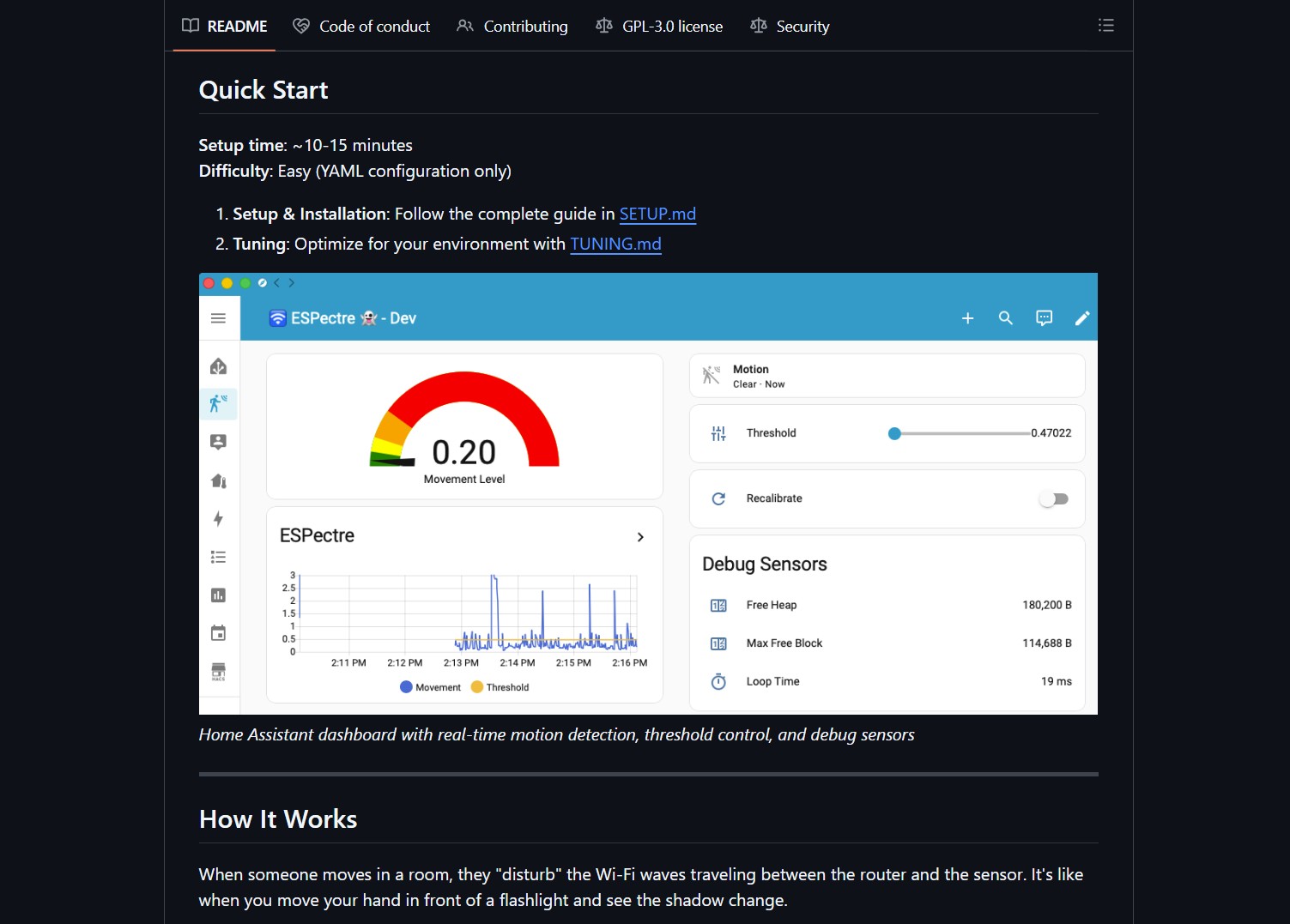
How It Works
The ESP32 samples Wi-Fi channel data, extracts spectral features, and flags motion based on signal changes. It integrates with ESPHome for exposing motion events to Home Assistant or publishing them over MQTT to any automation system. Setup takes about 10-15 minutes with a compatible board.
Quick start:
git clone https://github.com/francescopace/espectre.git
cd espectre
# follow the README to build and flash the firmware to an ESP32-S3 or supported board
For best results, use an ESP32-S3 or C6 and place the device where it has line-of-sight to key Wi-Fi paths. Like end-to-end encrypted tools that prioritize user control, E2ECP provides P2P encrypted file transfer with a similarly privacy-first approach.
Pros
- Works through walls, no camera required
- Low cost (~€10 ESP32), simple setup
- Privacy-friendly — no audio or video capture
- Easy Home Assistant integration via ESPHome
Cons
- May produce false positives depending on environment and traffic patterns
- Requires stable Wi-Fi and compatible hardware
- Not a replacement for camera-based detection if visual confirmation is needed
Try It Locally
git clone https://github.com/francescopace/espectre.git
cd espectre
# read the README for hardware recommendations and flashing instructions
Test on a staging network first. Signal-based detection can be sensitive to environmental changes — tune thresholds to avoid spurious triggers.
Project link:
https://github.com/francescopace/espectre
- Vibecode Terminal, Unified Agent Sandbox
E2ECP is a peer-to-peer file transfer tool that works from the web or the CLI. It enables direct, end-to-end encrypted..