GitHub is the largest library of open source code in the world, and that is exactly the problem. With hundreds of millions of repositories and no real native discovery layer, finding the projects that actually matter feels like searching for a single book in a library with no catalog.
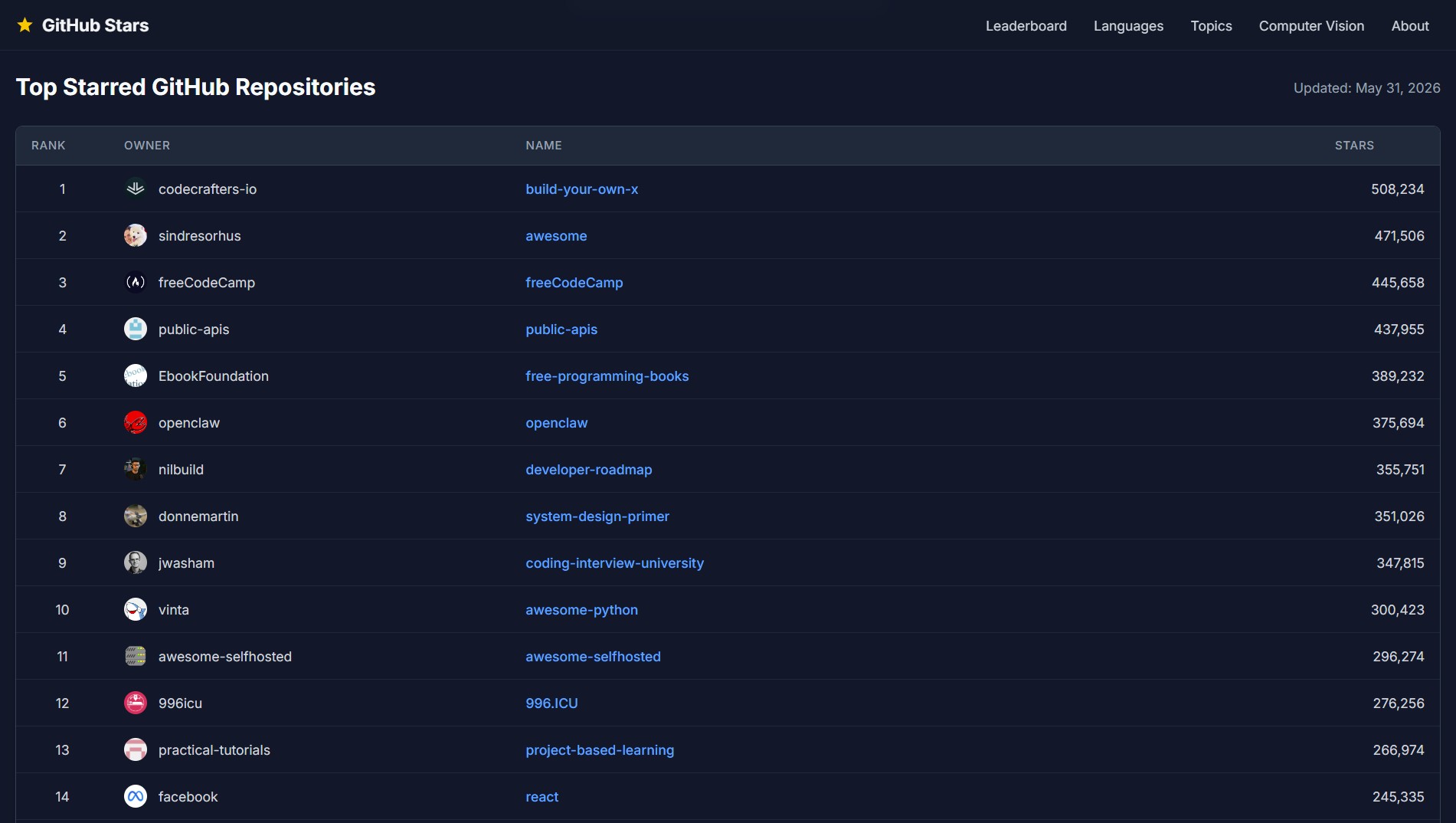
This article is for developers, open source contributors, indie hackers, and tech learners, and it solves the problem of discovering high quality and trending open source projects by providing a structured, daily updated leaderboard of the most starred GitHub repositories across languages and topics. The platform lives at http://githublb.vercel.app/.
The insight is straightforward. GitHub stars are a noisy but still useful proxy for project influence. When a repository has tens of thousands of stars, it usually means real developers are using it in production, not just bookmarking it. Aggregating those signals into a clean leaderboard turns GitHub from an endless feed into a ranked map.
Why GitHub Discovery is Broken
The standard ways developers find new projects all have the same weakness. They are either too short term, too biased, or too scattered.
- GitHub Trending: Shows what spiked in the last day or week. Useful for novelty, but it does not tell you which projects are foundational and which are just lucky.
- Twitter and Threads Recommendations: Loud, opinion driven, and heavily influenced by whoever is sponsoring the post. A project can trend for a week because of one influencer and then disappear.
- Word of Mouth: High quality, but slow, regional, and biased toward the social circle of whoever you ask.
- Scattered Blog Posts: Most “top 10 GitHub repos” lists are written once and never updated, so they quietly rot within months.
The result is that most developers only encounter the same handful of projects everyone else has heard of, and they miss the long tail of useful, well maintained tools that never get a viral moment.

What a Good GitHub Leaderboard Actually Does
A useful leaderboard is not just a sorted list of repositories. It is a discovery interface that answers the questions a developer actually has when they are learning a stack or evaluating a tool.
- Global View: See the most starred repositories overall, useful for understanding which projects have become industry standards.
- Language Filter: Drill down into the most popular repositories in a specific language, so a Python developer does not have to scroll past JavaScript projects to find what matters to them.
- Topic Filter: Browse by domain, such as web frameworks, machine learning, devops, or developer tools, to find projects solving a specific problem.
- Trending View: Spot the projects gaining stars fastest, which often signals a rising tool before it hits mainstream awareness.
- Maintainer Tracking: See which maintainers consistently produce high quality work. Following one good maintainer is often more valuable than following a topic.
Combined, these views turn GitHub into a queryable directory. Instead of guessing, a developer can answer questions like “what is the dominant Node.js backend framework in 2026” or “which Python AI agent projects are getting traction” in a single page.
Who This Resource is Actually for
The leaderboard format works for several groups, and each uses it differently.
- New developers use it as a roadmap. Seeing the top repositories in a language gives a clear list of projects worth studying.
- Intermediate developers use it for stack decisions. Before picking a library, they can check whether it has community weight behind it.
- Open source contributors use it to find healthy projects to contribute to, which is a better use of time than picking random repos with no momentum.
- Indie hackers use it to identify established tools they can build on top of, instead of reinventing the wheel.
- Tech learners use it as a reading list. Reading the source of well designed, widely used projects is one of the fastest ways to level up.
For all of these groups, the value is the same. A ranked view of GitHub collapses weeks of scattered exploration into a few minutes of intentional browsing.
How to Use it Well
A leaderboard is a starting point, not an answer. The best way to use it is to pick a few projects that look interesting, clone them, read the documentation, look at the issue tracker, and check the release cadence. Stars tell you a project is popular. Code quality tells you whether it is worth your time. A leaderboard narrows the list so you can spend more energy on the second step.
Pair the leaderboard with a personal rule. Spend 30 minutes a week browsing the top repositories in your primary language, read one README, and star one project that solves a problem you have had. Over a year, that habit alone will expose you to more relevant tools than any single course or newsletter.
Final Take
GitHub does not need more repositories. It needs better discovery. A daily updated leaderboard of the most starred repositories across languages and topics is one of the simplest ways to fix that, and it is exactly what http://githublb.vercel.app/ provides. Treat it as a weekly check in, a learning tool, and a reality check on what the developer community is actually using. The map is already drawn. The only thing missing was a place to view it cleanly.