Most AI image prompts produce one good image out of ten and nine variations that look nothing like the first one. The aesthetic drifts, the typography breaks, the color palette shifts, and the composition rearranges itself between runs. For designers and content creators who need consistent, on brand visuals across a campaign, this is the actual blocker.
AI Traveler K, a creator on Threads, has built a prompt template that solves this for travel poster style imagery, and the Scandinavian editorial aesthetic the template produces is one of the cleanest repeatable looks in AI image generation right now.
The prompt pack is built for AI designers, content creators, marketers, and prompt engineers, and it solves the most expensive problem in AI image generation, which is that consistency is the bottleneck, not quality.

The Problem with Most AI Design Prompts
Most AI image prompts fail for the same five reasons, and the failure pattern is identical across every generator, every model, and every user.
- Vague Subject Descriptions: “A travel poster” is not a prompt. It is a wish. The model fills the gap with whatever it wants, and what it wants is rarely what you wanted.
- No Style Specification: Without a named aesthetic, the model defaults to its training distribution, which is generic stock photo territory. The output looks like AI, not like editorial design.
- No Typography Control: Most prompts ignore typography entirely. The model invents text, scrambles letters, or skips text altogether. The output is unusable for any real poster work.
- No Layout Guidance: Composition is where editorial design lives. Without layout cues, the model produces a centered image with the subject floating in the middle.
- No Color Palette Anchor: “Beautiful colors” is not a palette. The model interprets this as maximum saturation, which is the opposite of the Scandinavian editorial look most designers are chasing.
The result is a string of generations that look related but are not consistent, and consistency is what makes a set of images usable as a campaign or a portfolio.

What the AI Traveler K Template Actually Controls
The prompt template from AI Traveler K, posted on Threads, is structured around the variables that actually determine whether an AI image looks like an editorial design or like AI generated content. It treats composition, style, typography, color palette, and layout as required fields, not optional ones.
- Composition: The template specifies framing, subject placement, and negative space. This is what makes the output feel designed instead of generated.
- Style: The Scandinavian editorial aesthetic is named explicitly, which anchors the model to a specific visual language instead of a generic distribution.
- Typography: The template includes font family, weight, sizing, and placement. This is the layer that breaks in most prompts, and it is the layer that makes the output usable as a real poster.
- Color Palette: A specific muted, earthy, desaturated palette is required. The model is not allowed to drift toward maximum saturation.
- Layout: The template controls grid, hierarchy, and whitespace. This is what separates editorial design from AI image generation.
The combination is what produces the clean, professional look that other prompts cannot reproduce, and the reason it works is that the template does not leave the important variables to the model’s interpretation.
Why This Matters for Designers and Marketers
The promise of AI image generation for design teams is volume and speed. The reality, until now, has been that every usable output requires a long iteration loop, and the output is rarely consistent enough to ship across a campaign. A structured template changes the economics.
- Faster First Run: A good template produces a usable output on the first or second try. The iteration loop collapses from twenty prompts to two.
- Consistency Across a Series: Travel posters need to look like a set. The template produces set level consistency because the variables are constrained across runs.
- Brand Alignment: For marketers, the Scandinavian editorial aesthetic is on brand for a huge range of premium and lifestyle products. The template is plug and play for that positioning.
- Usable as Real Design Output: The typography layer is the unlock. With controlled typography, the output is not just an image. It is a poster that can ship.
The shift is from “AI helps me sketch ideas” to “AI ships design output.” That is the line the template crosses.
Why Prompt Engineers Should Study This
For prompt engineers, the AI Traveler K template is a reference example of how to control a generative model at the level of design output, not just image content. Most prompt engineering tutorials stop at subject and style. This template goes five layers deeper.
- Structure Over String: The template is structured, not a string. Each variable has a slot. The prompt is a form, not a paragraph.
- Constraint as Quality: The constraints on color, typography, and layout are what produce the quality. Removing the constraints removes the look.
- Style Anchoring: Naming the aesthetic explicitly is the single highest leverage move in the template. Without it, nothing else works.
- Typography Is the Differentiator: Most AI prompts ignore typography. The few that do, like this one, are the ones that produce real design output.
The pattern generalizes. Any aesthetic that needs consistency across a set can be packaged as a structured template with named variables and constraints.
What People are Saying
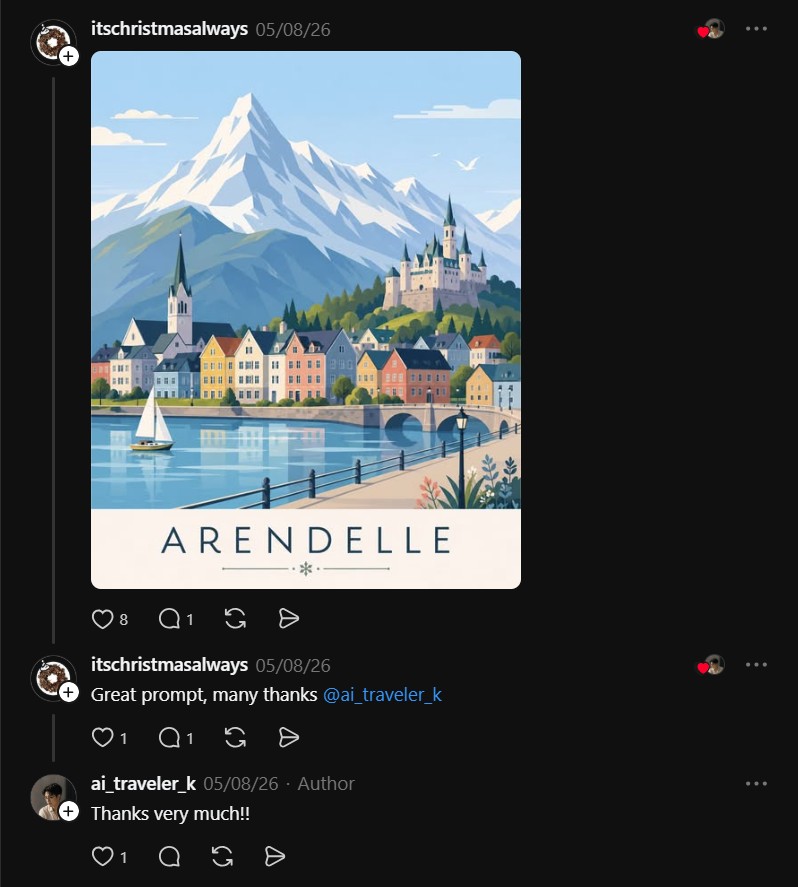
The template has been picked up across the Threads design community, and the reaction is the kind that signals it solves a real workflow problem.
“Great prompt, many thanks @ai_traveler_k”
@itschristmasalways
Short, direct, and the “many thanks” is the signal that the prompt actually worked on the first try. That is rare for AI image prompts.
Most AI image prompts produce inconsistent, generic output because they leave composition, style, typography, color palette, and layout to the model’s interpretation. AI Traveler K’s travel poster template, posted on Threads, controls all five variables explicitly and produces the clean, consistent Scandinavian editorial look that designers and marketers have been chasing.
If you are an AI designer, a content creator, a marketer, or a prompt engineer, study the template structure. The era of “describe a vibe and hope” is over. The era of structured, variable driven prompts that ship design output is here.