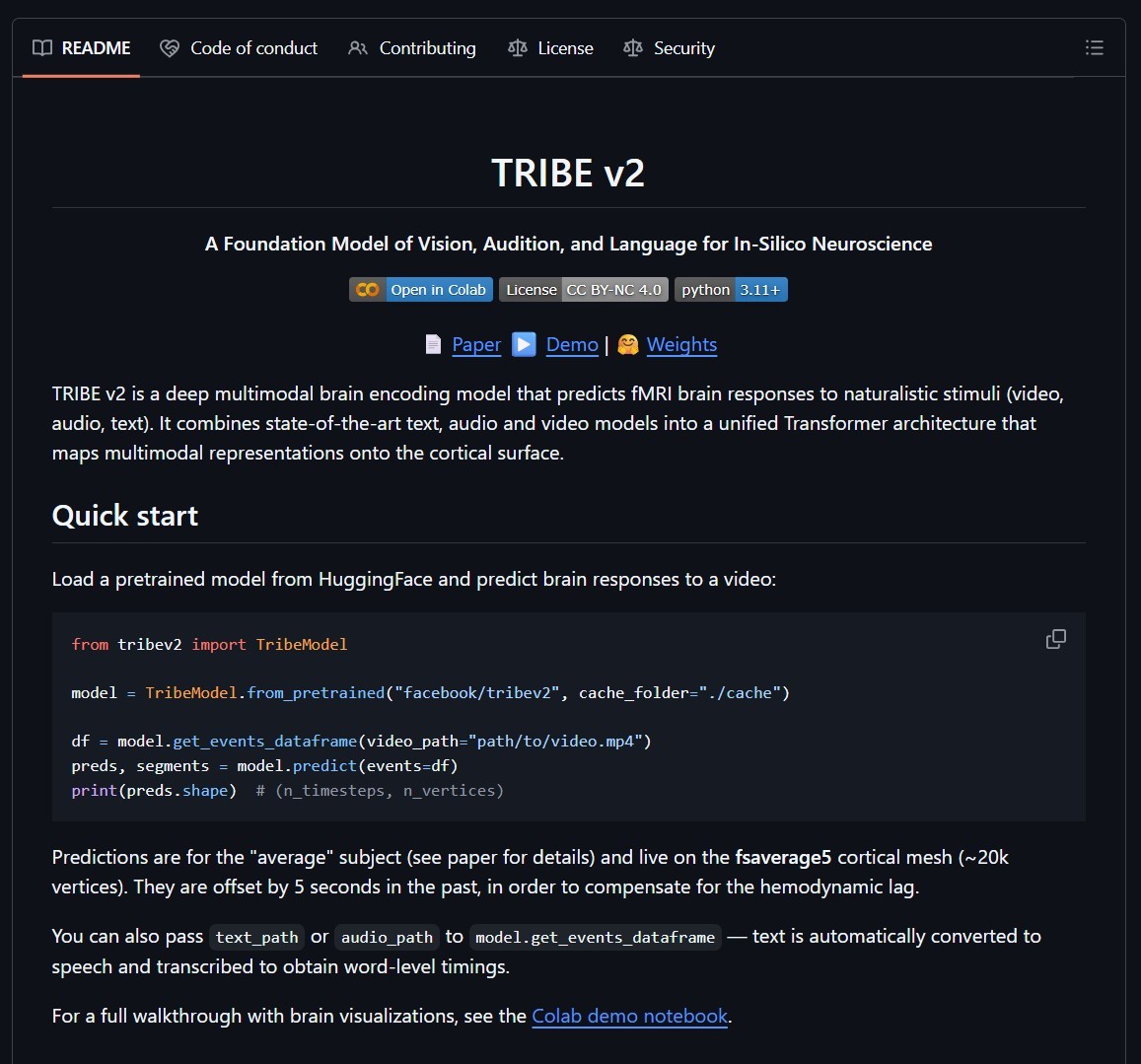
Meta FAIR quietly released something last week that most creators have not heard about yet, and it is one of the most important open source drops of the year. TRIBE v2, available at https://github.com/facebookresearch/tribev2, is a multimodal brain encoding model trained on fMRI scans that can predict how the human brain will respond to a video, frame by frame, before the video is ever published.
This is not a recommendation algorithm. It is not an engagement predictor. It is a model that simulates the average brain response to visual, audio, and text stimuli, and it is open source. Builders are already using it to score content before posting, and the implications for creators, advertisers, and AI researchers are significant.
The release is built for AI researchers, neuroscience teams, and advanced content and ML builders, and the problem it solves is the single biggest uncertainty in content creation, which is that you never know if your video will land until after you have already shipped it.
The Problem Every Creator Already Knows
Every creator has asked the same four questions before posting a video, and none of them had a good answer until now.
- Will People Actually Pay Attention: The first three seconds matter, but there is no way to know which three seconds of your edit are the right three. You guess, you post, and you find out after the algorithm has already decided.
- Which Part of the Video Is Engaging: The middle of a video is where most viewers drop off, and most creators cannot tell you why. The data does not exist before publishing.
- What Triggers Memory or Emotional Response: A video can get views and still be forgotten. The question of whether the content will actually stick in memory is a different question than views, and there has been no tool for it.
- Why Do Some Clips Perform Better Than Others: The honest answer is that creators do not know. They pattern match from past winners, but the underlying cognitive mechanics are invisible.
The traditional solution is the wrong solution. A/B testing happens after publishing, when the algorithm has already pushed or buried the video. User studies are expensive. Focus groups are slow. By the time the analytics tell you which clip won, the moment has passed. The feedback loop is broken by design, and TRIBE v2 is the first tool that fixes the loop by running the prediction before the post.

What TRIBE v2 Actually Does
TRIBE v2 is a multimodal brain encoding model trained on three datasets that most researchers would kill for: fMRI brain scans, video and audio and text stimuli, and human neural response patterns in attention, emotion, and memory regions of the brain. The output is a model that can simulate the average brain response to a piece of content.
- Predicts Attention and Emotion Per Segment: The model scores which parts of a video activate attention regions and which parts trigger emotional response, frame by frame.
- Simulates Average Brain Response: It does not predict individual viewers. It predicts the average neural response across the population it was trained on, which is exactly what most creators and advertisers care about anyway.
- Identifies High Impact and Low Impact Segments: The creator can edit the video, run it through TRIBE, and see which segments are predicted to land and which are predicted to fall flat.
- Enables Neural Level Scoring of Creative Content: This is the part that matters. It is a scoring layer for content, where the score is based on neuroscience rather than engagement metrics that come after the fact.
For the first time, the creator can test content before it goes live, refine the edit based on predicted cognitive impact, and optimize the storytelling flow scientifically instead of by gut feel.
Why This Matters for Creators and Advertisers
The pre publishing prediction loop is the missing piece of every content stack. Right now, every creator is flying blind until the post is live, and every advertiser is burning budget on creative that the audience will forget by morning. TRIBE v2 changes the order of operations.
- Test Before Publish: Run the edit through the model, see what the brain prediction looks like, and revise before spending distribution budget.
- Refine the Edit Based on Cognitive Data: If the middle of the video is predicted to lose attention, that is the segment to cut. If the opening is predicted to trigger memory encoding, that is the segment to keep.
- Optimize Ads, Thumbnails, and Storytelling Flow Scientifically: A/B testing after publishing is a lag indicator. Neural prediction is a lead indicator, and lead indicators always beat lag indicators.
This is the closest thing the industry has to a “brain score” for creative work, and Meta just open sourced it.
What People are Saying
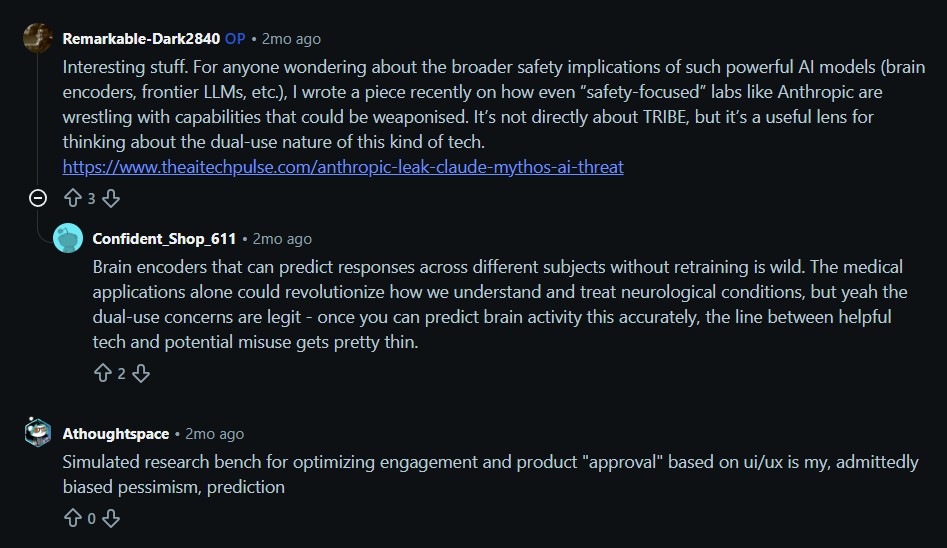
The release has caught attention across AI and neuroscience communities, and the reaction is a mix of excitement and caution about dual use.
“Interesting stuff. For anyone wondering about the broader safety implications of such powerful AI models (brain encoders, frontier LLMs, etc.), I wrote a piece recently on how even ‘safety focused’ labs like Anthropic are wrestling with capabilities that could be weaponised. It’s not directly about TRIBE, but it’s a useful lens for thinking about the dual use nature of this kind of tech.”
u/Remarkable-Dark2840
“Brain encoders that can predict responses across different subjects without retraining is wild. The medical applications alone could revolutionize how we understand and treat neurological conditions, but yeah the dual use concerns are legit. Once you can predict brain activity this accurately, the line between helpful tech and potential misuse gets pretty thin.”
u/Confident_Shop_611
The medical and research applications are real, and so are the dual use risks. This is frontier technology, and it deserves the same level of public scrutiny that any other predictive model of human behavior receives.
The Limits That Matter
TRIBE v2 is research grade, not a finished consumer product, and the limits are worth naming.
- Average Brain, Not Individual Audience: The model simulates the average neural response. A specific demographic, a specific cultural context, or a specific niche audience may respond differently, and the model does not capture that.
- Cultural and Context Specific Reactions Differ: A piece of content that lands in the US may not land in Japan, and the average brain model averages that out.
- Research Grade, Not Virality Prediction: This is a tool for understanding cognitive impact, not a guaranteed predictor of whether a video will go viral. Do not treat the brain score as the engagement score.
Meta FAIR just open sourced a model that predicts how the human brain responds to your video before you post it, and it is available at https://github.com/facebookresearch/tribev2. For the first time, creators and researchers can score content on a neuroscience basis instead of guessing on gut feel, and the implication for the creative industry is the same as every other predictive model shift.
The people who use the tool will outperform the people who do not. If you are a creator, an advertiser, an ML builder, or a researcher, clone the repo, run your last video through it, and see what the brain prediction says. The feedback loop just got faster, and it now runs before the post.