Most Threads creators are optimizing the wrong thing. They obsess over the hook, the topic, the posting time, and the follower count, and they still cannot explain why a good post flops and a throwaway post spikes. The reason is that the Threads algorithm does not distribute posts one at a time.
It distributes them as a system, and your last 10 posts are quietly training the audience for your next one. This is for Threads creators, growth marketers, and personal brands who are tired of inconsistent reach and want to understand how distribution actually works.
The insight is simple and uncomfortable. Reach on Threads is cumulative, not per post.
The Wrong Model of Threads Growth
The default model most creators carry around looks like this. Write a strong hook. Pick a topic that the algorithm likes. Post at the right time. Get distribution. Repeat. It sounds logical, and it is also the reason most accounts stall.
The model breaks because:
- Hooks only affect the current post. A great hook can win one battle and still lose the war, because distribution is decided after the post, by the audience it was shown to.
- Timing does not fix weak audience sampling. If your last 10 posts trained the algorithm to show your work to the wrong people, posting at 9am will not save you.
- Follower count is not the bottleneck. Most accounts are not limited by their follower size. They are limited by the quality of the audience that actually sees the post first.
- Engagement bait does not improve audience quality. A controversial reply bait might spike one post, but it also pollutes the next audience sample with people who will never engage with your real content.
The result is what creators call “random” reach. It is not random. It is the predictable output of a cumulative system that most people are ignoring.

How the Threads Algorithm Actually Works
The distribution model that actually matches the data has three layers.
- Circle A: The First Audience. Every new post is first shown to a small initial group. This is the test audience. The size is small, but the composition is everything.
- Circle B and Beyond: The Expansion Layer. If Circle A engages, the post expands to larger circles. If Circle A does not engage, the post dies quietly, no matter how good the post itself was.
Audience Quality Is Built From Your Last 10 Posts. The algorithm builds Circle A from people who interacted with your last several posts. This is the lever that almost no one talks about, and it is the reason your past performance shapes your next post’s reach.
The practical implication is harsh but useful. Your last 10 posts are not just content. They are training data. They tell the algorithm who you are for, and they shape who your next post is shown to first.
Why Common Advice Keeps Failing
Most growth advice on Threads is built for a per post model, so it does not work in a cumulative system.
- “Write a better hook.” Better than what. If your Circle A is full of the wrong people, a better hook just gets the wrong people to engage slightly more.
- “Post at the right time.” Timing helps a weak audience less than you think. Audience composition matters more than the hour of the day.
- “Post more often.” Volume helps only if each post improves audience quality. Low effort posts that get a few random likes will train the algorithm the wrong way.
- “Ride trends.” Trends bring temporary reach but usually drag in an audience that will not engage with your real content. That audience then becomes part of your Circle A for the next post.
The shift is to stop asking “how do I make this post go viral” and start asking “how do I make my next 10 posts train a better audience.”
What Creators Who Get It Do Differently
The creators whose reach compounds do a few things consistently.
- Build Engagement Loops: They reply to the same accounts they want as their core audience. Over time, those accounts become part of their Circle A.
- Focus on Meaningful Replies: Not the performative kind. Real replies that pull the right kind of people into conversation.
- Avoid Low Effort Posts: Memes and bait can spike, but if the audience they pull in does not match the audience you want, you are poisoning your distribution for later.
- Treat Every Post as Training Data: They ask one question before posting. Will the people who engage with this post be the people I want as my audience next week.
This is a slower strategy than viral hacking, and it is the only one that compounds.
What People are Saying
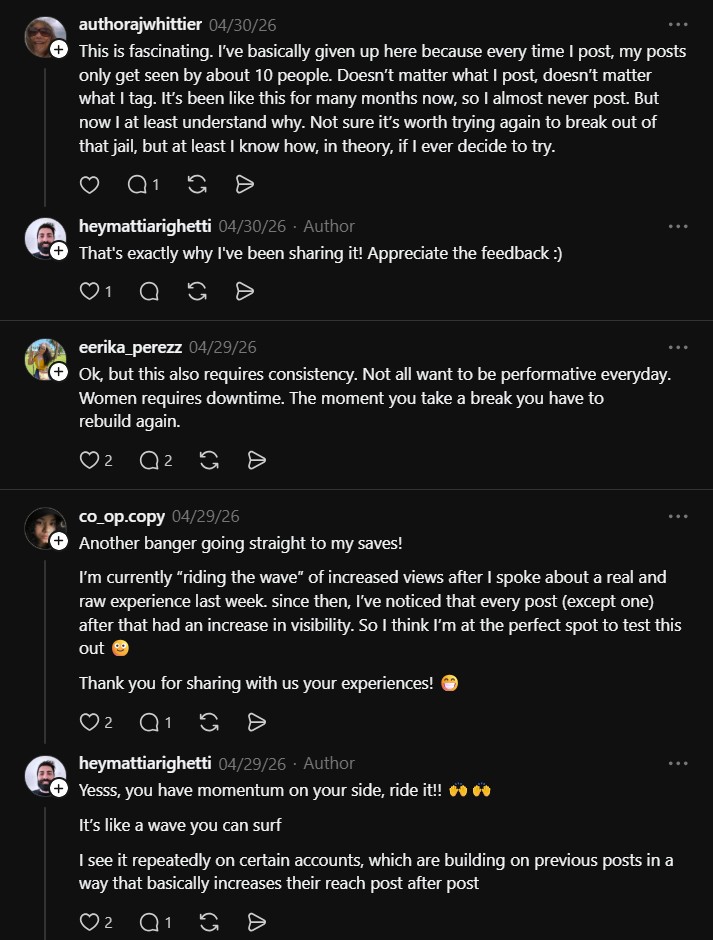
The creator community is starting to notice this pattern, and the reactions are useful signals.
vinylizabeth (@vinylizabeth) said:
“I like Threads because I feel like people aren’t worrying about any of this and just connecting.”
This captures a real benefit of the platform. For people who do not care about growth, the cumulative model is a feature, not a bug. It rewards genuine connection over performance.
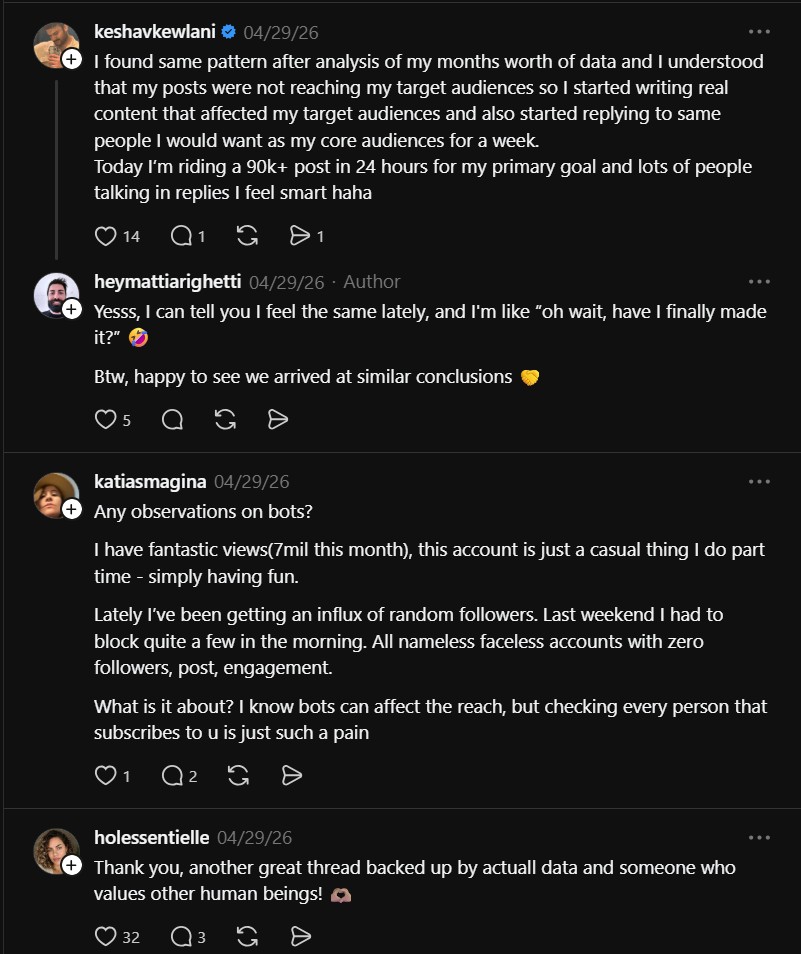
keshavkewlani (@keshavkewlani) said:
“I found same pattern after analysis of my months worth of data and I understood that my posts were not reaching my target audiences so I started writing real content that affected my target audiences and also started replying to same people I would want as my core audiences for a week. Today I’m riding a 90k+ post in 24 hours for my primary goal and lots of people talking in replies I feel smart haha.”
This is the most useful quote in the thread. It is a first person case study of the exact strategy above, and the 90k+ post in 24 hours is the kind of result that makes the cumulative model worth taking seriously.
holessentielle (@holessentielle) said:
“Thank you, another great thread backed up by actuall data and someone who values other human beings!”
This is a reminder that the audience for Threads values substance. The platforms that reward data backed thinking will keep rewarding it, because that is the kind of content the algorithm learns to show to more people like the people who engaged with the last one.
Final Take
Stop optimizing the post. Start optimizing the audience. The next 10 posts you publish on Threads are not just content. They are the training data that decides who sees the post after that. Write for the people you want to reach, reply to the people you want to keep, and treat low effort engagement as a tax on your future reach. That is the only growth strategy on Threads that actually compounds.