
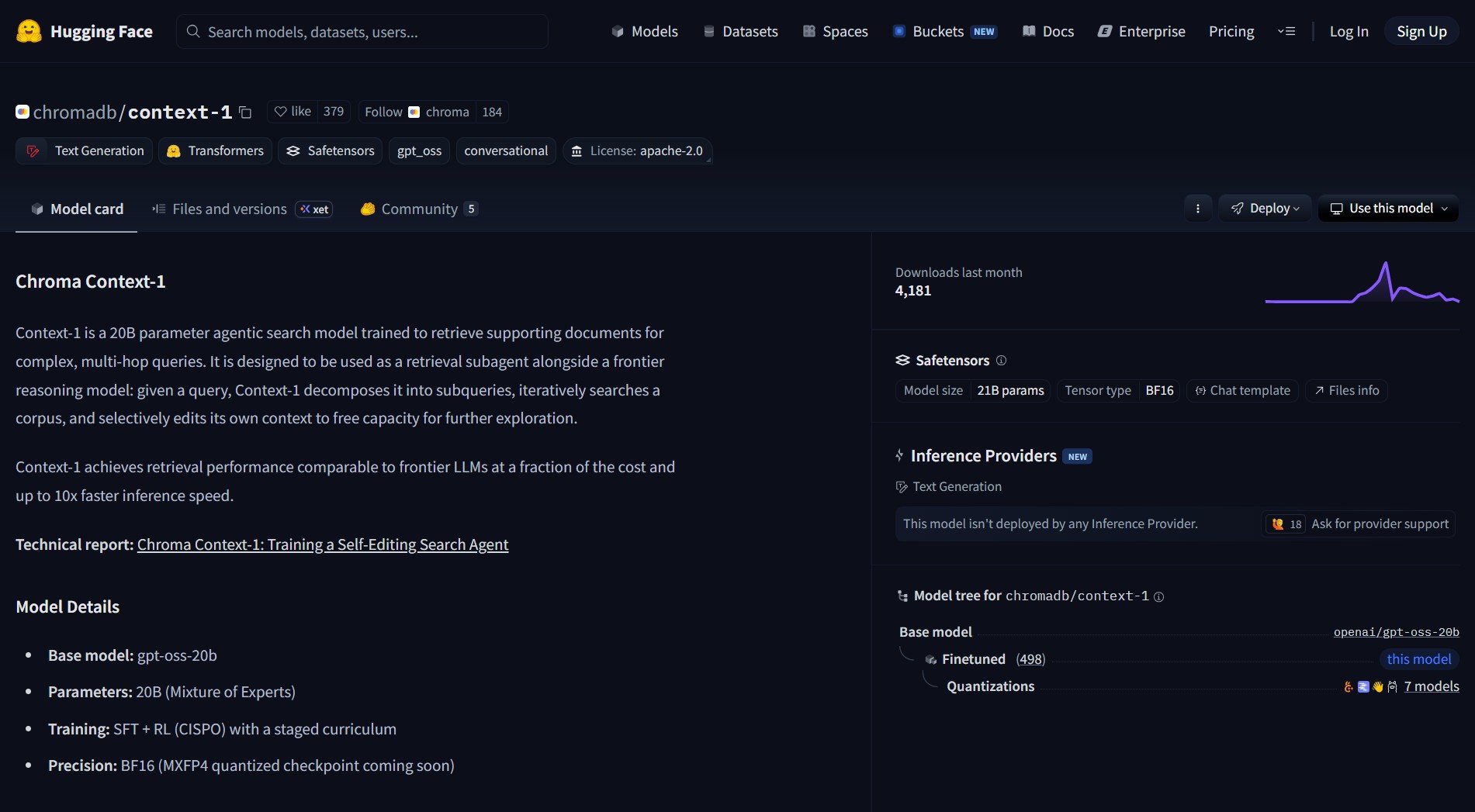
Chroma just open-sourced Context-1, a 20B parameter agentic search model designed to retrieve supporting documents for complex, multi-hop queries. The model is intended as a retrieval subagent that decomposes queries, iteratively searches a corpus, and edits its own context to free capacity for further exploration. The result is retrieval performance comparable to frontier LLMs at much lower cost and faster inference.
Context-1 runs locally and is built for high-quality, low-latency retrieval. It is aimed at developers building retrieval-augmented systems (RAG) who want instant, private search without round trips to cloud endpoints. For alternative approaches to document retrieval, check out how to sync 3D scenes across Windows with Three.js — a different take on local-first tooling.
How It Works
Context-1 decomposes a complex query into smaller subqueries, searches a local corpus for supporting documents, and selectively edits or prunes context to keep the retrieval loop efficient. This iterative decomposition and retrieval pattern helps surface evidence for multi-step questions while keeping latency low.
Key Capabilities
- Purpose — Fast, high-quality local document retrieval for RAG workflows
- Size — 20B parameters optimized for speed and footprint
- Runtime — Designed to run locally, examples show MacBook-class inference
- Pairing — Intended alongside a frontier reasoning model for best results
Pros and Cons
- Pros: Open-source and runnable locally with no cloud lock-in, competitive retrieval quality, lower inference cost and faster query turnaround
- Cons: Requires local compute with larger collections needing more RAM or CPU, best used as a retrieval subagent not a full reasoning model, deployment needs integration work
For a complementary retrieval approach, see how to transfer files securely with E2ECP P2P encryption — another tool that prioritizes privacy and local-first operation.
Try It Locally
- Visit the model page on Hugging Face: https://huggingface.co/chromadb/context-1 and read the README and examples
- Follow upstream instructions for inference — typical approaches include Hugging Face Transformers or Accelerate
- Integrate Context-1 as the retrieval step in your RAG pipeline and pair it with a stronger reasoning model for final answer synthesis
Local inference performance depends on hardware, quantization strategy, and corpus size. Validate memory and latency on representative data before adopting it for production workflows.
Project link:
https://huggingface.co/chromadb/context-1
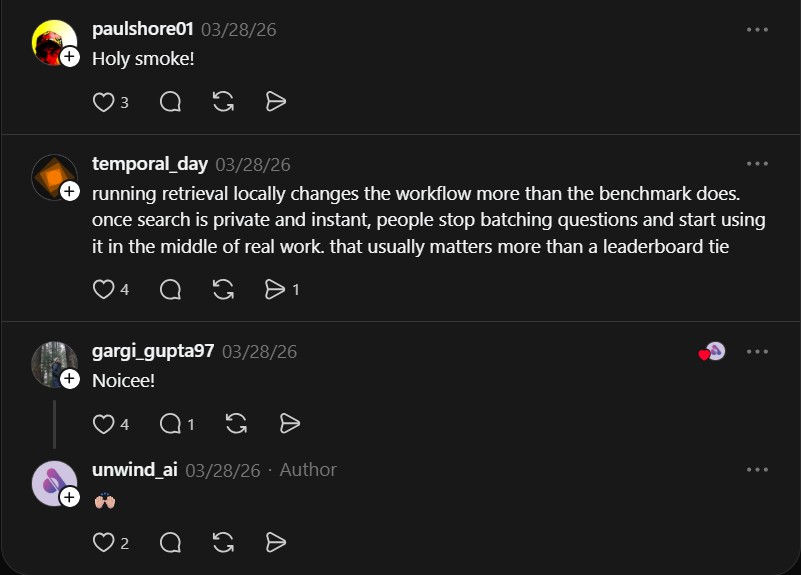
“Running retrieval locally changes the workflow more than the benchmark does. Once search is private and instant, people stop batching questions and start using it in the middle of real work. That usually matters more than a leaderboard tie.” — @temporal_day
- How to Use Velo as a Local-First Desktop Email Client
Velo is a blazing-fast, keyboard-first desktop email client with local SQLite storage Velo is a desktop Gmail client built with..
- How to Use PentAGI for Autonomous AI Red Teaming
PentAGI is an autonomous AI red team system that performs penetration testing with zero human input PentAGI is a fully..
- How to Use Dexter for Autonomous Financial Research
Dexter is an autonomous financial research agent that plans, executes, and validates its own investment analysis Dexter is an autonomous..
- How to Use PageIndex for Vectorless RAG on Complex Documents
Badge PageIndex argues that similarity is not the same as relevance, and it offers a vectorless, reasoning based approach to..
- How to Use OpenWork as a Desktop Interface for DeepAgents
Badge OpenWork is an opinionated desktop interface for deepagentsjs, it exposes filesystem planning, subagent delegation, and direct tool access so..
- How to Use Lightpanda as a Fast Headless Browser for Agents
Badge Lightpanda Browser is a headless browser written from scratch in Zig, built specifically for AI agents and automation workflows…