The “I want to work in AI” crowd is the largest beginner audience on the internet right now, and most of them are stuck. They are stuck in tutorial hell, stuck choosing between five different courses, or stuck in the wrong direction entirely. This roadmap is for those beginners, the people who know they want to work in AI but do not know where to start, and it solves the only question that actually matters. What do I study, in what order, and when do I know I am ready.
The roadmap is opinionated on purpose. There is a specific sequence, monthly milestones, and practice projects attached to every stage, so the only decision the learner has to make is to keep going.

The “What Do I Study” Problem
Most AI learning attempts fail before they start, not because the learner is not smart enough, but because the field is too noisy. The internet is full of advice, and almost none of it is structured.
The three failure modes are predictable:
- Too Theoretical: Beginners drown in linear algebra, probability, and the math of backpropagation before they ever touch a useful tool. Useful later, but a poor first 6 months for someone trying to get employable.
- Too Shallow: Other beginners skip the engineering entirely and call themselves AI engineers because they can write a prompt. The market does not hire that. The market hires people who can ship systems.
- No Structure At All: The most common outcome. The learner hops between YouTube playlists, blog posts, and a half finished course, and never builds anything they can show.
All three paths end the same way. Six months in, the learner has nothing to put on a resume and no proof they can build.

The Sequence That Actually Works
The roadmap that produces employable AI engineers in 6 months is a strict sequence, not a buffet.
- Month 1: Python. Not advanced Python, not ML Python, just clean, production style Python. File handling, APIs, environment management, basic testing. This is the foundation that every later step assumes.
- Month 2: LLM APIs. Learn to call OpenAI, Anthropic, or open source equivalents. Build small tools that take a prompt, call a model, and return structured output. This is where most beginners start to feel momentum.
- Month 3: RAG. Retrieval Augmented Generation is the workhorse of real world AI products. Learn vector databases, embeddings, chunking, and how to wire them into a real app. By the end of this month, the learner can build a working AI assistant over a custom dataset.
- Month 4: Agents. Move from single call apps to multi step agents. Learn tool use, planning, memory, and the patterns that make agents reliable instead of demo magic. This is the differentiator that separates junior engineers from mid level ones.
- Month 5: Deployment. An AI project that lives only on localhost is a hobby, not a portfolio piece. Learn to deploy to a real environment, handle environment variables, monitor costs, and keep an API key out of the repo.
- Month 6: Specialization. Pick a vertical. AI for code, AI for customer support, AI for healthcare, AI for finance. Build one serious project in that vertical that goes deeper than anything else in the portfolio.
Each step has resources attached so there is no decision fatigue. The point is not to read everything. The point is to finish each stage and produce a project.
Why Monthly Milestones Matter
A reading list does not produce engineers. Shipping does. That is why this roadmap is built around monthly milestones and concrete practice projects, not courses.
- A milestone forces a deadline. Without one, learning drifts.
- A project forces integration. Reading about RAG is not the same as debugging a chunking strategy at 2am.
- A portfolio is a forcing function for depth. The first project is shallow, the third is not, and by month 6 the learner has a body of work that proves they can ship.
The transition from consumer to builder happens in the gap between “I read about it” and “I built it.” The roadmap closes that gap by treating the project as the unit of progress, not the lesson.
Who This is Actually for
This roadmap is not for people who want to “explore AI.” It is for people who want a job.
- Beginners Who Want a Clear Path: People who have some coding exposure, maybe from a bootcamp, a degree, or self teaching, and want a structured route to a real AI engineering role.
- Developers Pivoting Into AI: Engineers from web, mobile, or backend who know how to ship software and want to apply that skill set to AI products.
- Tutorial Hell Refugees: Learners who have finished three courses and still cannot build anything original. The structure forces them out of consumption mode.
- Self Driven Learners Without a Mentor: People who do not have access to senior AI engineers, and need a roadmap that does the prioritization for them.
If you are a researcher aiming for a PhD level ML theory path, this is not your roadmap. There is a different one, and it is longer and more academic.
What People are Saying
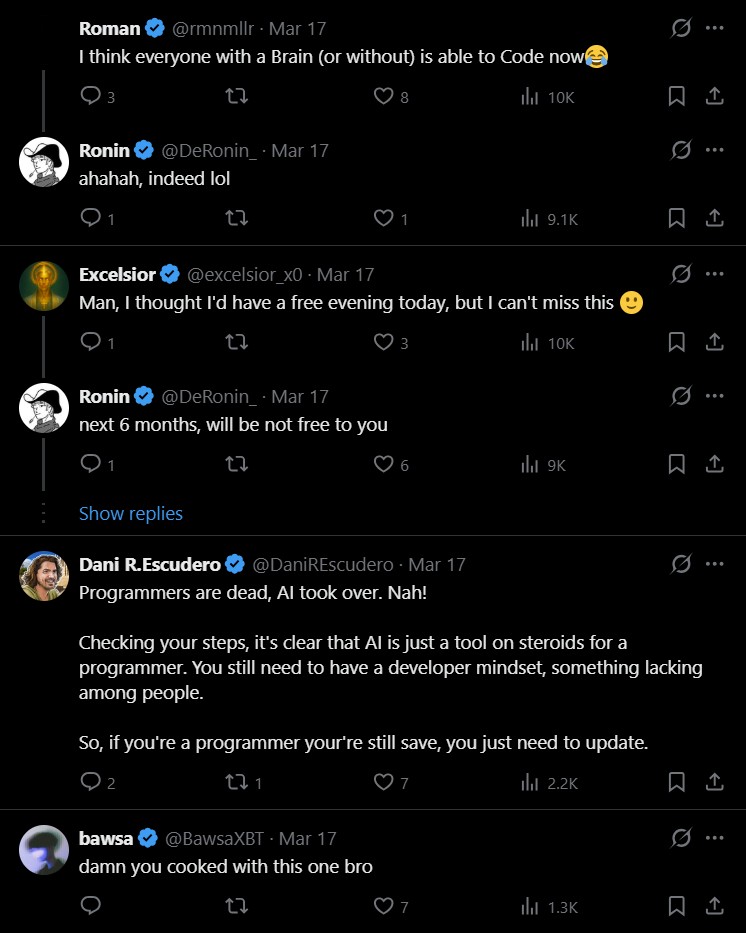
The reaction from the developer community is sharp, and it is worth paying attention to.
DaniREscudero (@DaniREscudero) said:
“Programmers are dead, AI took over. Nah! Checking your steps, it’s clear that AI is just a tool on steroids for a programmer. You still need to have a developer mindset, something lacking among people. So, if you’re a programmer you’re still safe, you just need to update.”
This is the most important framing in the entire thread. The roadmap is built for developers, not for people who think coding is optional. AI has not replaced engineering. It has raised the bar for what engineers are expected to ship.
maxchadwick (@maxchadwick) said:
“bookmarked and reading this tonight. your content actually made me more interested in machine intelligence and thing I can do and create with it.”
This is the second reaction a roadmap should aim for. Not just “good post” but “I am actually going to act on this.” Bookmarking without execution is the failure mode this roadmap was designed to prevent, and posts that move people from reading to doing are rare enough to be worth noting.
Final Take
Do not start with the math. Do not start with the prompt. Start with Python, then LLM APIs, then RAG, then agents, then deployment, then a vertical. Ship one project per month for 6 months and you will be employable in a way that the average “I watched a course” candidate is not. The roadmap is not glamorous, but it is the only one that produces engineers instead of consumers.