Most children learn about light, reflection, and optics through diagrams in a textbook, and most of them remember none of it, because a flat diagram of a light ray does not show what light actually does.
The Ide Tips 2026 Homemade 3D Hologram educational toy, sold on Shopee, fixes this by turning the lesson into a physical, interactive model that kids build themselves, and the build is the lesson. The result is that abstract concepts like light reflection, optical illusion, and holographic projection stop being theoretical and start being visible, and that shift is the entire point of a good STEM educational toy.
The toy is built for parents, teachers, STEM educators, and kids aged roughly 6 to 14, and it works as a low cost, hands on introduction to physics concepts that usually stay locked in a textbook until high school.
The Problem with How Kids Learn Optics Today
The standard approach to teaching light and reflection in primary education is to draw a light ray on a whiteboard, label the angle of incidence and the angle of reflection, and ask the class to memorize the diagram. This works for a small fraction of students, and it fails for the rest, because the lesson is happening entirely in the abstract.
- Diagrams Do Not Match Reality: A textbook diagram of a light ray bending through a prism is a 2D abstraction. A child who has never seen the experiment cannot connect the diagram to the real phenomenon.
- Theory Before Observation: Students are asked to learn the rule before they have seen the rule in action. The result is rote memorization, not understanding.
- No Physical Engagement: A worksheet on reflection has no feedback loop. The student writes an answer, the teacher marks it, and the lesson ends. There is no exploration.
- Expensive Lab Equipment: A real optics lab with lasers, prisms, and projection rigs is not available in most schools and not available at home. The gap between the textbook and the lab is where most STEM learning dies.
- Parents Lack Teaching Tools: A parent who wants to support STEM learning at home has limited options. Books and videos are the default, and both are passive.
The result is that light and optics, one of the most visually dramatic topics in physics, is taught as one of the dullest. The Homemade 3D Hologram toy rebuilds the lesson from observation upward.

What the Homemade 3D Hologram Actually Does
The kit is a DIY build that uses a plastic pyramid, a smartphone, and a video file to project a 3D hologram effect on the phone screen. The build is the educational core.
- The Build Itself Is the Lesson: Assembling the pyramid from the plastic sheets teaches fine motor skills, spatial reasoning, and the geometry of a 3D projection surface.
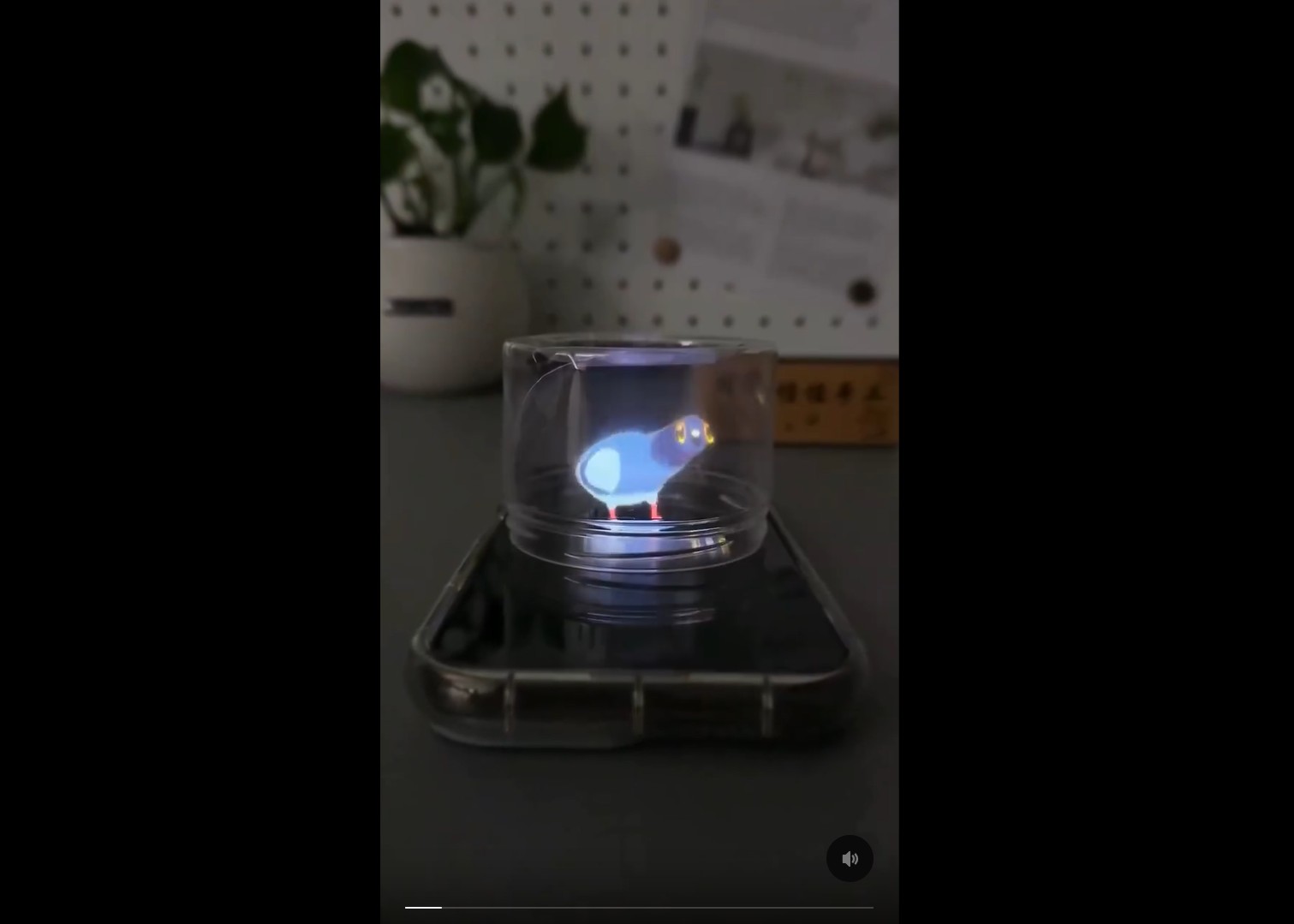
- The Smartphone Acts as the Light Source: A video plays on the phone, and the pyramid reflects the light into a 3D image that appears to float in the center. The child sees a hologram being produced in real time.
- The Visual Effect Anchors the Concept: A 3D hologram that appears to float in mid air is the kind of visual moment a child never forgets. The concept of reflection, projection, and 3D imaging lands because the effect is dramatic.
- The Setup Is Reusable: Once built, the pyramid can be used with any compatible hologram video. The child can experiment with different source material and see the effect across multiple images.
- The Cost Is Low: The kit is priced for the Indonesian consumer market on Shopee, and the components are minimal. This is a STEM toy that does not require a school budget.
Why This Matters for Parents and Educators
For parents, the value is that a single kit turns a smartphone, which is usually a passive entertainment device, into a STEM learning tool. The phone is the projector, the pyramid is the lens, and the lesson is the visual effect. The child is doing physics, not watching physics.
For teachers, the value is a low cost classroom demonstration that actually works. A hologram projection in front of a class is a teaching moment that no diagram can match, and the kit is cheap enough to be deployed across an entire class.
- Visual Learning Anchor: The hologram effect is the kind of moment children remember years later. The concept of light projection sticks because it is anchored to a striking image.
- Hands On STEM: The build teaches geometry, the operation teaches optics, and the result teaches 3D imaging. Three STEM topics in one kit.
- Inexpensive Entry Point: Most STEM kits in the optics category cost 5 to 10 times more. The Ide Tips 2026 kit is accessible.
- Indoor Activity: A clean, contained, screen based activity that works in any room. Useful for rainy days, classroom demonstrations, and homeschool sessions.
Why This is a Good 2026 STEM Toy
The Indonesian STEM toy market has grown fast, but most of the products are still either expensive imported kits or generic science toys with weak educational depth. The Ide Tips 2026 Homemade 3D Hologram stands out because it hits three qualities that matter.
- The Build Is Real: This is not a toy that demonstrates a concept. The child builds the device that demonstrates the concept. The construction is the lesson.
- The Effect Is Real: The hologram projection actually works. Children can show it to family and friends, and the effect is dramatic enough to spark a real conversation about how light and reflection work.
- The Price Is Real: The kit is in the low to mid price range on Shopee, which is the right band for the target market. Premium pricing would kill the adoption curve.
For parents looking for a low cost STEM gift, for teachers looking for a classroom demonstration, and for homeschool families looking for a hands on physics activity, this kit is a strong fit for 2026.
Link to the product:
https://shopee.co.id/product/1645849831/41222993935
The Homemade 3D Hologram educational toy by Ide Tips 2026, sold on Shopee, is the rare STEM kit that delivers a real build, a real visual effect, and a real physics lesson at a price parents can afford. Most optics toys in the market teach a concept through a diagram or a model.
This one teaches the concept by letting the child build the projector, run the hologram, and watch a 3D image appear in mid air. For 2026, this is a strong pick for parents, teachers, and STEM educators who want learning to be visual, hands on, and memorable.