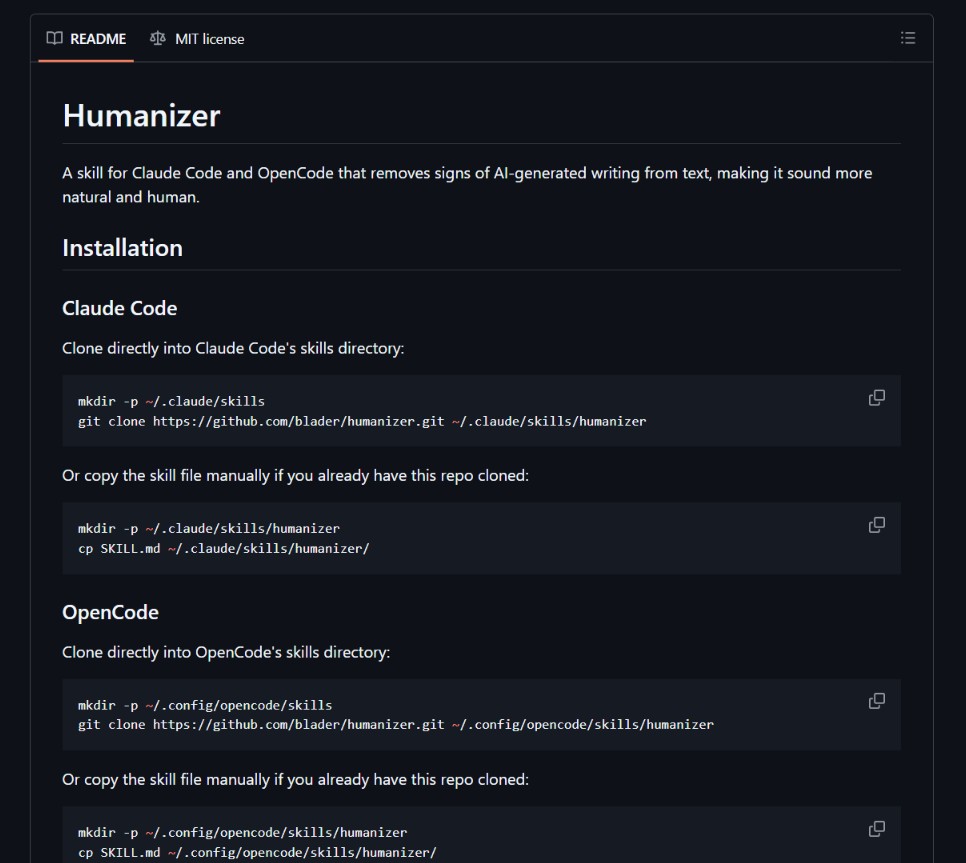
A developer going by blader just dropped one of the most useful Claude Code skills of 2026, and the project is solving a problem that has been quietly frustrating every writer who uses AI as part of their workflow.
The repository is called Humanizer, and it works as a Claude Code skill that detects 29 specific writing patterns from Wikipedia’s “Signs of AI writing” guide, then rewrites the text to actually sound human. The patterns include em dashes, the rule of three, “it’s not just X, it’s Y” constructions, sycophantic openers, and a long list of other tells that have become the fingerprint of machine generated prose. The whole thing is open source.
This is not a paraphraser. It is a targeted rewriter that knows exactly what makes AI writing sound like AI writing, and it fixes those patterns while preserving the original meaning.
The Problem Most AI Writing Tools Leave on the Floor
The current state of AI assisted writing has a tell problem. Models like Claude and GPT are excellent at producing structured, fluent text, but they also produce the same predictable patterns over and over. Readers have learned to spot them, and the tells are getting easier to identify every month.
- Em dashes show up in nearly every long form AI output, even when a comma or period would read better
- The rule of three (“fast, accurate, and reliable”) appears in almost every paragraph that lists benefits
- “It’s not just X, it’s Y” constructions have become a signature opener for AI essays
- Sycophantic openers (“Great question!” “Certainly!”) leak through despite instruction prompts telling the model to avoid them
- Sentence length and rhythm become mechanical because the model converges on the same statistical patterns
- Vocabulary drifts toward the same handful of words: “delve,” “robust,” “leverage,” “navigate,” “landscape”
These tells do not mean the writing is bad. They mean it is recognizable, and recognizability is what the Humanizer skill is built to fix.

What is Actually in the Repository
The repo ships a working Claude Code skill with a clear, focused feature set.
- 29 Pattern Detection: The skill checks text against 29 specific patterns drawn from Wikipedia’s “Signs of AI writing” guide, which is one of the most referenced community resources on AI writing tells
- Targeted Rewriting: Rather than paraphrasing the whole text, the skill rewrites only the parts that match the patterns, which preserves voice and avoids introducing new tells
- Em Dash Removal: The skill specifically targets em dashes, which have become the most recognizable single tell in AI writing in 2026
- Rule of Three Breaking: Lists that follow the predictable three item pattern get reshaped into something that reads more like a human wrote it
- Sycophancy Stripping: Openers and closers that sound like customer service responses get rewritten into something a human would actually say
- Meaning Preservation: The rewrite keeps the original argument, the original structure, and the original tone, so the only thing that changes is the surface fingerprint
This is the rare AI writing tool that knows what AI writing sounds like and knows how to fix it without ruining the content underneath.
Who This is for
The audience for Humanizer is anyone who writes with AI assistance and cares about the output reading naturally.
- Writers: Authors, journalists, and bloggers who use AI as a drafting partner but want the final text to sound like their own voice
- Content Creators: Substack writers, newsletter authors, and indie media creators who have noticed their drafts sound “off” but cannot pinpoint why
- Marketers: Copywriters and growth marketers producing high volume content who need each piece to read as a human wrote it
- Students: Graduate students and academic writers who need to submit work that does not trigger AI detection flags or read like a chatbot output
- Developers: Engineers writing documentation, technical posts, and blog content with AI assistance who want the final draft to read like a developer wrote it
- AI Users in General: Anyone who has been told their writing “sounds like AI” and wants a tool that fixes the specific patterns causing that perception
If you have ever felt that an AI drafted paragraph was technically fine but obviously not yours, this skill is for you.
What People are Saying
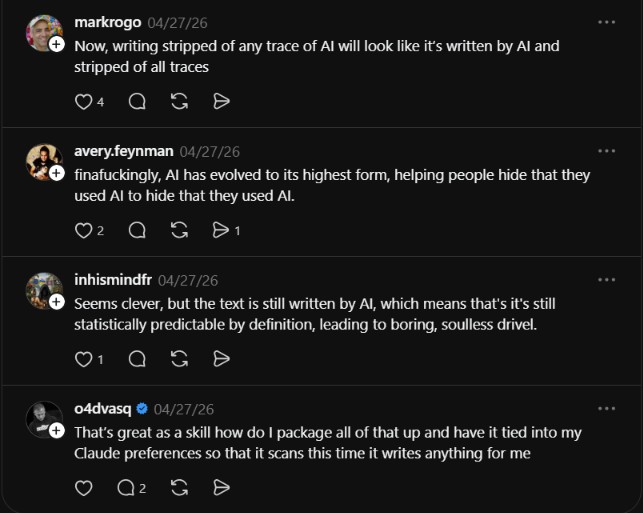
The community reaction has been quick and unusually direct, which is fitting for a tool that exists to fix AI tells.
“finafuckingly, AI has evolved to its highest form, helping people hide that they used AI to hide that they used AI.”
@avery.feynman
“That’s great as a skill how do I package all of that up and have it tied into my Claude preferences so that it scans this time it writes anything for me”
@o4dvasq
The first quote captures the meta humor of the situation, which is that the next layer of AI tooling is built to make AI output look less like AI output. The second quote is more practical and points at the real opportunity, which is wiring Humanizer into Claude’s preferences so the rewriting happens during the original draft rather than after. That is the right instinct, and it is where this kind of tool becomes invisible infrastructure rather than a manual cleanup step.
Why This Repo Matters for AI Assisted Writing
The bigger story is not the skill itself. It is what becomes possible when AI writing stops sounding like AI writing by default.
- The Quality Bar Rises: When AI assisted text reads as natural, the conversation shifts from “is this AI” to “is this good,” which is where the conversation should have been all along
- Writer Voice Survives: Tools like Humanizer make AI a drafting partner rather than a voice replacement, which is better for writers and better for readers
- The Detection Arms Race Levels Off: Rather than playing whack a mole with detection tools, this approach fixes the patterns at the source, which is more sustainable than trying to evade classifiers
- Open Source Beats Vendor Lock In: The skill is open source, so any Claude user can install it, modify the pattern list, and contribute new tells as AI writing evolves
- Workflow Integration Is the Next Step: The natural next move is to make Humanizer a default Claude Code skill that runs during generation rather than as a post processor, which the community is already asking for
Repo: https://github.com/blader/humanizer
Humanizer is the Claude Code skill that solves the most visible problem in AI assisted writing, which is that AI writing sounds like AI writing. The project is small, focused, and immediately useful, which is the right shape for a skill in this category.
Anyone who writes with Claude should install it, run it on a recent draft, and see how many of the 29 patterns show up in their own text. The number will be higher than expected, and that is exactly why this skill matters. AI is the best drafting partner most writers have ever had. Humanizer makes sure the final draft still sounds like the writer, and that distinction is what separates an AI assisted author from an AI generated author in 2026.