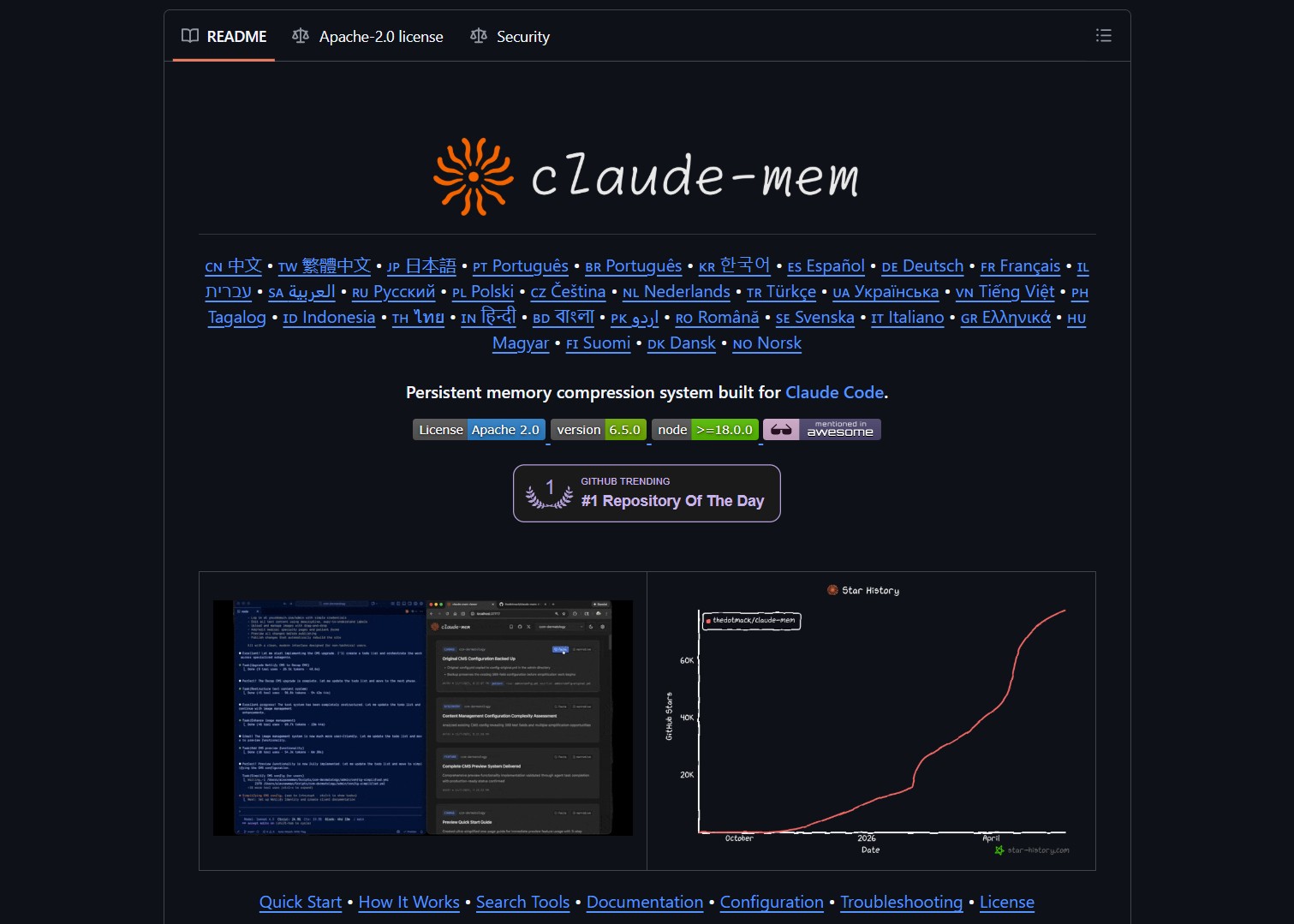
If you use Claude Code for serious development work, you have probably felt the friction of restarting a session and rebuilding context from scratch. Project conventions, architecture decisions, and previous debugging attempts disappear the moment the conversation ends. Claude-Mem solves this by giving Claude Code persistent, reusable memory that survives across sessions, so the assistant actually remembers your project instead of asking the same onboarding questions every morning.
The repository lives at https://github.com/thedotmack/claude-mem and is built specifically for developers running Claude Code as part of a daily workflow. The core idea is simple but technically interesting: store structured observations, summaries, and user context outside the conversation window, then surface the relevant pieces automatically when a new session starts.
What the Tool Actually Does
Claude-Mem acts as a memory layer between you and Claude Code. Instead of treating every chat as a blank slate, it captures what happened in previous sessions, indexes it, and feeds the most relevant context back into the model when a new conversation begins.
The main capabilities that matter for developers:
- Persistent Context: Stores project knowledge, decisions, and conventions across sessions, including code style preferences, architecture notes, and recurring tasks.
- Automatic Recall: When you start Claude Code, relevant memory is injected into the prompt so the model continues where it left off, no manual copy pasting of a project brief.
- Observation Capture: Records key moments during a session, such as bug fixes, refactors, and user preferences, then converts them into structured, searchable memory.
- Lightweight Integration: Designed to slot into Claude Code without a heavy setup process or external database dependency.
- Workflow Continuity: Particularly useful for long running projects where requirements evolve and the same files and patterns are revisited repeatedly.
For a developer juggling multiple repositories, this is the difference between treating Claude Code as a search engine and treating it as a collaborator that actually knows your codebase.

Why This Approach Works
The traditional workaround is to maintain a project README, a CLAUDE.md file, or a custom system prompt with project context. That works for static information, but it does not capture the dynamic stuff, such as why a certain tradeoff was made last week, which approach got rejected, or what the user keeps telling the model to stop doing.
Claude-Mem addresses that gap by treating memory as an evolving artifact. Observations accumulate, get summarized, and get prioritized by relevance. Over time the memory file becomes a compressed history of how the project has been built, which is far more useful for an AI assistant than a static description of what the project is.
It is also workflow agnostic. Whether you are doing data analysis in R, refactoring a backend service, or building a small CLI tool, the memory is the same shape and the integration cost stays low.
What Developers are Saying
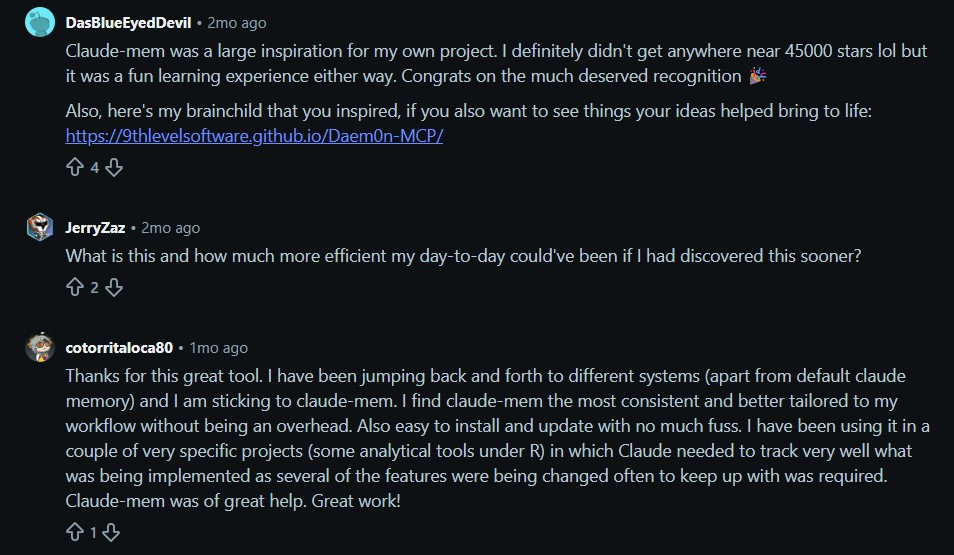
Community reaction has been strong, and the project has clearly inspired adjacent work in the space.
DasBlueEyedDevil (u/DasBlueEyedDevil) said:
“Claude-mem was a large inspiration for my own project. I definitely didn’t get anywhere near 45000 stars lol but it was a fun learning experience either way. Congrats on the much deserved recognition. Also, here’s my brainchild that you inspired, if you also want to see things your ideas helped bring to life: https://9thlevelsoftware.github.io/Daem0n-MCP/”
That comment highlights two things: claude-mem hit a real pain point that other developers felt strongly enough to fork the concept, and the original implementation reached a scale that competitors openly cite as a benchmark.
cotorritaloca80 (u/cotorritaloca80) said:
“Thanks for this great tool. I have been jumping back and forth to different systems (apart from default claude memory) and I am sticking to claude-mem. I find claude-mem the most consistent and better tailored to my workflow without being an overhead. Also easy to install and update with no much fuss. I have been using it in a couple of very specific projects (some analytical tools under R) in which Claude needed to track very well what was being implemented as several of the features were being changed often to keep up with was required. Claude-mem was of great help. Great work!”
That second quote is especially useful for technical readers because it names a concrete use case. R based analytical projects often involve many small, fast changing features, exactly the kind of work where context loss between sessions hurts the most. The fact that claude-mem stayed consistent across iterations and feature churn is a strong signal about the reliability of the memory pipeline.
Project Resources
- GitHub Repository: https://github.com/thedotmack/claude-mem
- Inspired project mentioned by the community: https://9thlevelsoftware.github.io/Daem0n-MCP/