

GLM-OCR is a multimodal OCR model designed for complex document understanding, and the maintainers provide an Ollama friendly workflow so you can run it locally with no API keys and no data leaving your machine. For browser-based document handling, pdfcraft offers a different approach to processing private PDFs entirely client-side.
What it is
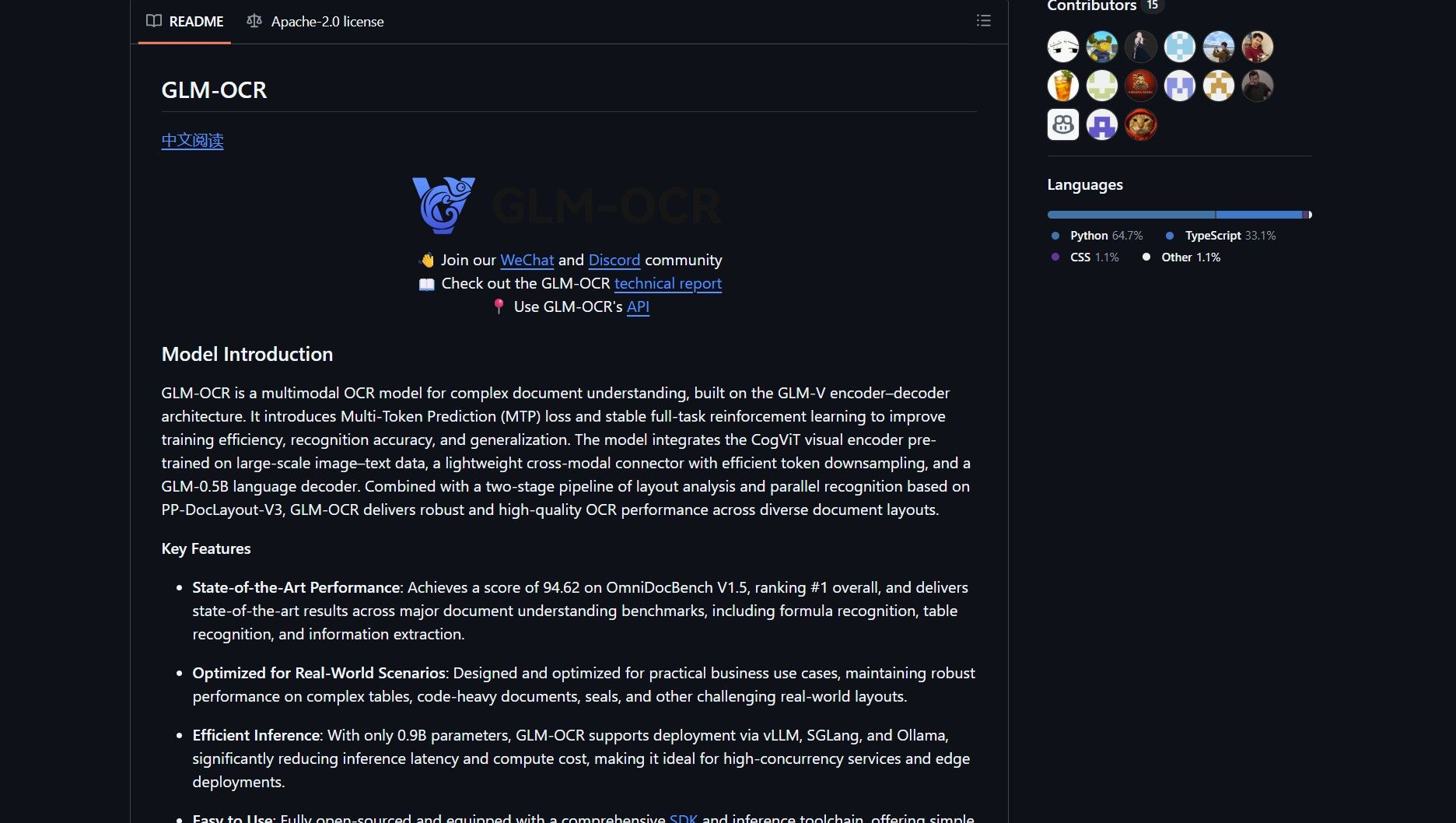
GLM-OCR (zai-org) packages a multimodal OCR stack around the GLM-V encoder–decoder architecture, paired with a GLM-0.5B language decoder. It introduces Multi-Token Prediction (MTP) loss and a two stage pipeline using PP-DocLayout-V3 for layout analysis, then runs parallel recognition across detected regions. The result is a model that handles diverse document layouts with high accuracy, and importantly, runs locally via Ollama or similar runtimes.
GLM-OCR is intended for on device inference, which reduces cost and data exposure. Local runtime performance depends on your hardware and chosen quantization or optimization strategy.
How it works
At a high level, GLM-OCR combines a vision encoder pre trained on image–text corpora, a compact cross modal connector that downsamples tokens efficiently, and a decoder trained with MTP loss. A two stage pipeline first performs layout analysis, then runs recognition in parallel across layout regions to improve throughput and accuracy, especially on complex documents. If you are building multimodal AI workflows, Genkit provides a production framework for integrating vision and structured outputs.
# quick start
git clone https://github.com/zai-org/GLM-OCR.git
cd GLM-OCR
# follow upstream README for Ollama or HF Transformers based local inference
| Feature | Notes |
|---|---|
| Architecture | GLM-V encoder, GLM-0.5B decoder, cross modal connector |
| Loss | Multi-Token Prediction (MTP) to speed training and improve accuracy |
| Pipeline | Layout analysis (PP-DocLayout-V3) + parallel recognition |
| Runtime | Local inference, Ollama recommended for easy local deployment |
If you plan to run many documents, benchmark different quantization and batching strategies, and profile memory use on representative files before deploying to production.
Pros and cons
Pros
- Runs locally, no cloud costs or API keys
- Robust on complex layouts thanks to layout analysis, and parallel recognition
- Open source, so you can adapt the pipeline for specialized document types
Cons
- Local inference requires compute, quantization and runtime tuning may be necessary
- Integration work required for high volume or automated pipelines
- Not a turnkey cloud OCR replacement if you need managed scaling or SLAs
Try it locally
- Visit the repo on GitHub and read the installation notes: https://github.com/zai-org/GLM-OCR
- Use Ollama for the simplest local workflow, or run with HF Transformers and Accelerate if you need custom inference knobs.
Project link
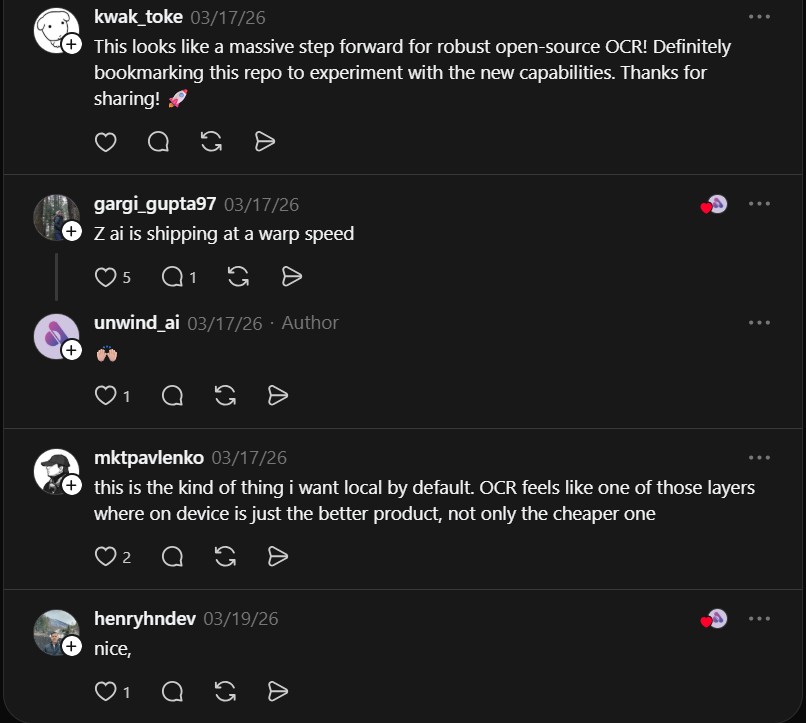
Here are what peoples are saying:
“This looks like a massive step forward for robust open-source OCR! Definitely bookmarking this repo to experiment with the new capabilities. Thanks for sharing! 🚀” @kwak_toke
“this is the kind of thing i want local by default. OCR feels like one of those layers where on device is just the better product, not only the cheaper one” @mktpavlenko
Quick commands and examples
# clone and inspect
git clone https://github.com/zai-org/GLM-OCR.git
ls GLM-OCR
# follow README for Ollama or HF based inference examples
If you enjoy articles about top GitHub repositories like this, don’t forget to subscribe to Technolati.com.
- How to Run PicoClaw as an Ultra-Lightweight AI Assistant
PicoClaw is a Go-based AI assistant that runs on $10 hardware with under 10MB of RAM PicoClaw is an ultra-lightweight..
- How to Run Hermes Agent Desktop as a Native Windows AI Agent
Hermes Agent Desktop by RedWoodOG wraps the NousResearch Hermes Agent in a WinUI 3, .NET 10 desktop app. It gives..
- How to Run Hermes Agent as a Persistent Terminal AI Assistant
Hermes Agent is an open-source, terminal-first AI assistant from Nous Research that lives in your terminal or on a server…
- How to Run 1-Bit LLMs on CPU with BitNet.cpp
BitNet.cpp is Microsoft’s official inference framework for 1-bit LLMs. It enables running very large quantized models on standard CPUs without..
- How to Run Moltbot AI Assistants in Cloudflare Workers
Moltworker is a serverless deployment pattern that runs Moltbot AI assistants inside Cloudflare Workers. It uses R2 for memory storage..
- How to Run Durable Autonomous Agents in Production with Gobii
Gobii is an open-source platform for running durable autonomous agents in production. It solves the problem of unreliable, ephemeral AI..