

PageIndex argues that similarity is not the same as relevance, and it offers a vectorless, reasoning based approach to retrieval that builds a hierarchical page index and uses LLM-driven tree search to find the most relevant sections. The claim is bold, it reports 98.7% on FinanceBench, and the repo is worth a close look if you work with complex documents.

PageIndex is designed for single or long-document retrieval scenarios where structure and reasoning matter more than nearest neighbor similarity.
What it is
PageIndex (VectifyAI) is a vectorless retrieval system for retrieval augmented generation workflows. Instead of embedding and chunking, it builds a hierarchical table of contents, then uses an LLM to reason over that index with a tree search strategy, much like how an expert would consult a long document. While Chroma Context-1 focuses on local agentic search with embeddings, PageIndex takes the opposite route by eliminating vectors entirely and relying on structured reasoning.
How it works
At a high level PageIndex performs retrieval in two steps:
- Generate a tree style table of contents from the document, splitting content into meaningful page or section nodes.
- Run a reasoning based tree search that expands promising nodes, uses the LLM to score relevance, and prunes branches to focus on the most relevant passages.
This retrieval approach is a strong alternative for developers who have tried BRAG and want a different paradigm that avoids embedding pipelines, especially for single-document scenarios with deep structural hierarchy.
# quick start
git clone https://github.com/VectifyAI/PageIndex.git
cd PageIndex
# follow README for example indexing and retrieval commands
| Feature | Notes |
|---|---|
| Vectorless retrieval | No embeddings, no vector DB, no chunking |
| Hierarchical index | Tree structure mirrors document layout and semantics |
| Reasoning search | LLM guided tree search to find relevant sections |
| Use case | Long reports, manuals, finance docs, legal briefs |
Pair PageIndex with a strong reasoning model for final answer synthesis, PageIndex focuses on relevance selection rather than answer generation.
Pros and cons
Pros
- Avoids vector DB complexity and indexing costs
- Better alignment with true relevance for long, structured documents
- Compact index, interpretable tree search, and strong single document performance
Cons
- May not scale as well for large multi document corpora without additional orchestration
- Depends on the reasoning model to score and expand nodes accurately
- Requires work to integrate into existing RAG pipelines that expect embeddings
Try it locally
- Clone the repo and read the examples to build a tree index from sample documents.
- Run the supplied retrieval scripts and compare results against a vector baseline on representative tasks.
This approach shines on single long documents, but multi document setups may need additional design. Validate on your dataset before committing to a full migration away from vector search.
Project link
Here are what people are saying:
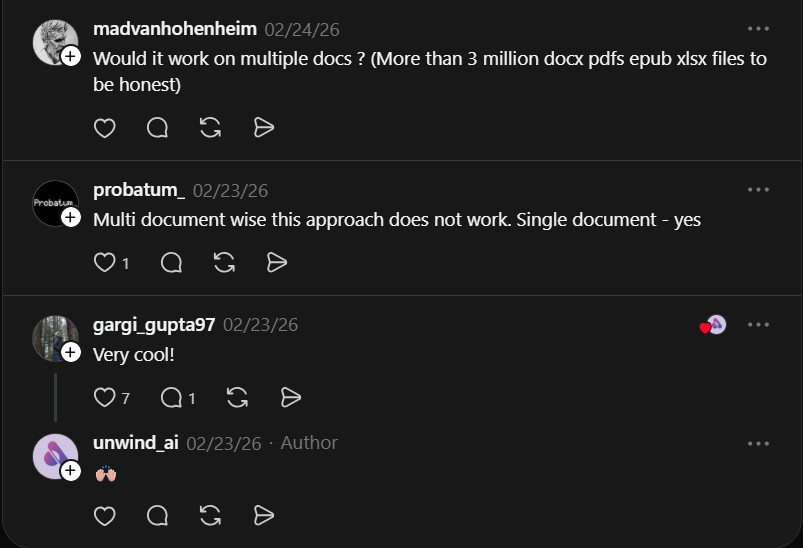
“Multi document wise this approach does not work. Single document – yes” @probatum_
If you enjoy articles about top GitHub repositories like this, don’t forget to subscribe to Technolati.com.
- How to Use Velo as a Local-First Desktop Email Client
Velo is a blazing-fast, keyboard-first desktop email client with local SQLite storage Velo is a desktop Gmail client built with..
- How to Use PentAGI for Autonomous AI Red Teaming
PentAGI is an autonomous AI red team system that performs penetration testing with zero human input PentAGI is a fully..
- How to Use Dexter for Autonomous Financial Research
Dexter is an autonomous financial research agent that plans, executes, and validates its own investment analysis Dexter is an autonomous..
- How to Use OpenWork as a Desktop Interface for DeepAgents
Badge OpenWork is an opinionated desktop interface for deepagentsjs, it exposes filesystem planning, subagent delegation, and direct tool access so..
- How to Use Lightpanda as a Fast Headless Browser for Agents
Badge Lightpanda Browser is a headless browser written from scratch in Zig, built specifically for AI agents and automation workflows…
- How to Use Activepieces for No-Code AI Agent Automation
Activepieces is an open source alternative to Zapier that provides a visual canvas to build AI agent workflows and exposes..