Most TikTok creators do not fail because they lack ideas. They fail because they design videos without understanding what the recommendation system actually measures. Reach on TikTok is not random, it is the direct output of a few very specific user behaviors that the algorithm can detect within the first few hundred impressions. This article breaks down the mechanics of TikTok distribution and translates them into concrete video design rules that creators can apply frame by frame.
The audience for this is TikTok creators, influencers, and businesses using TikTok as a real growth channel, not hobbyists posting casually. If you are stuck in the 200 to 1000 view range, or you feel like your content is inconsistent where one video pops and the next one flops, the issue is almost never your niche. It is your video architecture.
How TikTok Distribution Actually Works
TikTok is a retention engine disguised as a social app. The recommendation system, often called the For You Page algorithm, ranks videos based on signals that all point to one underlying metric: did the viewer keep watching.
The signals that matter most:
- Watch Time and Retention: The single most important metric. Longer cumulative watch time, especially from the start of the video, signals high quality content.
- Completion Rate: Whether viewers finish the video. A short video with a high completion rate often outperforms a longer video with a 30 percent completion.
- First Three to Five Seconds: The hook window. If viewers skip early, the video gets throttled in the next distribution pool.
- Rewatch Behavior: Loops, replays, and rewatches are a strong positive signal, which is why satisfying, repeatable visuals tend to do well.
- Early Feed Test Performance: TikTok shows your video to a small test group first, around 200 to 500 viewers. Their behavior decides if it gets pushed further.
Likes, comments, and shares matter, but they are secondary. They are weak proxies compared to actual watch behavior. This is why videos that feel low effort but hold attention can outperform polished content that loses viewers in the first second.

Video Design Rules That Map to the Algorithm
Once you understand the signals, video design becomes a series of engineering decisions. Every element should be tested against one question: does this increase watch time?
- Strong Hook in the First Three Seconds: Open with a visual that disrupts the scroll, a question, a bold claim, a contradiction, or a movement that catches the eye. Never start with a logo, a slow intro, or a calm wide shot.
- No Slow Intros: Every second before the payoff is a second where retention can drop. Cut directly to the point.
- Structured Pacing: Build curiosity rather than revealing everything early. Use pattern interrupts every 3 to 7 seconds: a new angle, a zoom, a text overlay, or a sound change.
- Fast and Clean Editing: Jump cuts, b-roll changes, and visual movement all reset attention. Stagnant frames invite skips.
- Visual Clarity: Use large subjects, full screen focus, and subtitles so the video works with sound off. A huge portion of TikTok traffic starts muted.
- Payoff at the End: Do not drag the conclusion. Deliver the value and stop. A clean ending often increases completion rate.
- Iterate from Analytics: Check average watch time, not just views. A video with 800 views and 80 percent watch time is worth more than one with 50,000 views and 20 percent.
Posting frequency matters too, but only as a multiplier. High volume posting without retention focused design is just fast content creation. Combine volume with iteration, and the algorithm starts to learn your audience.
What Creators are Saying
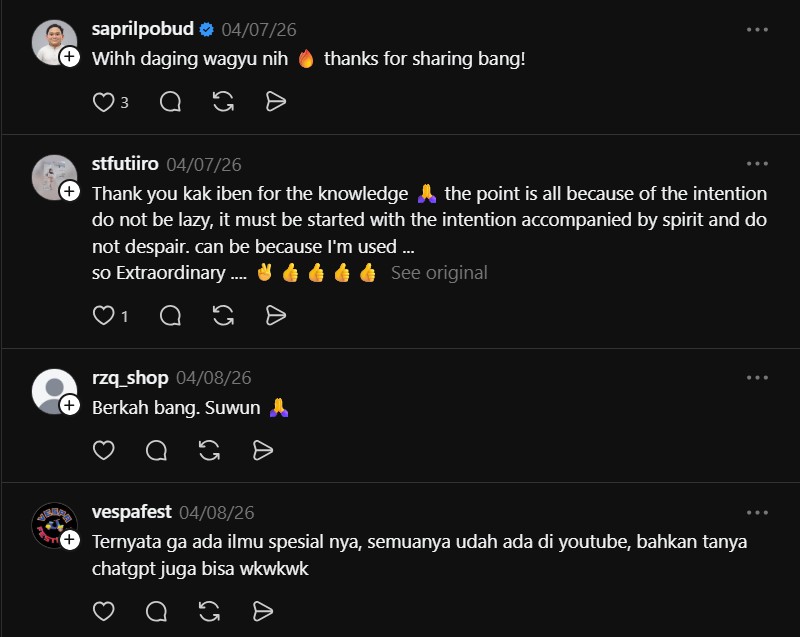
The reaction from the TikTok creator community shows how hungry people are for this kind of structural breakdown, because most TikTok advice online is about hashtags and trends, not the underlying mechanics.
saprilpobud (@saprilpobud) said:
“Wow, this is wagyu beef, thanks for sharing, bro!”
The term wagyu beef is creator slang for premium, high value content. That kind of reaction usually means the advice felt rare and actionable rather than generic.
stfutiiro (@stfutiiro) said:
“Thank you kak iben for the knowledge. The point is all because of the intention, do not be lazy, it must be started with the intention accompanied by spirit and do not despair. Can be because I’m used to it, so extraordinary.”
This comment shows the mindset shift the content triggers. Once a creator understands the algorithm, the inconsistency stops feeling like luck and starts feeling like a skill problem, which is much more motivating.
rianpratamarusli (@rianpratamarusli) said:
“Thanks for the knowledge, bro. I’ll try it next time I make content.”
Simple, but the key signal here is intent to apply. That is exactly how the algorithm feedback loop is supposed to work: the creator applies a principle, the next video performs slightly better, and the data confirms the change.
Final Take
If your TikTok content feels random, the fix is not a new niche, a new face, or a new trend. The fix is treating every video as a retention test and designing the structure around the signals the algorithm can actually measure. Hook, pacing, clarity, payoff. Do those four things well, and the FYP distribution takes care of itself.