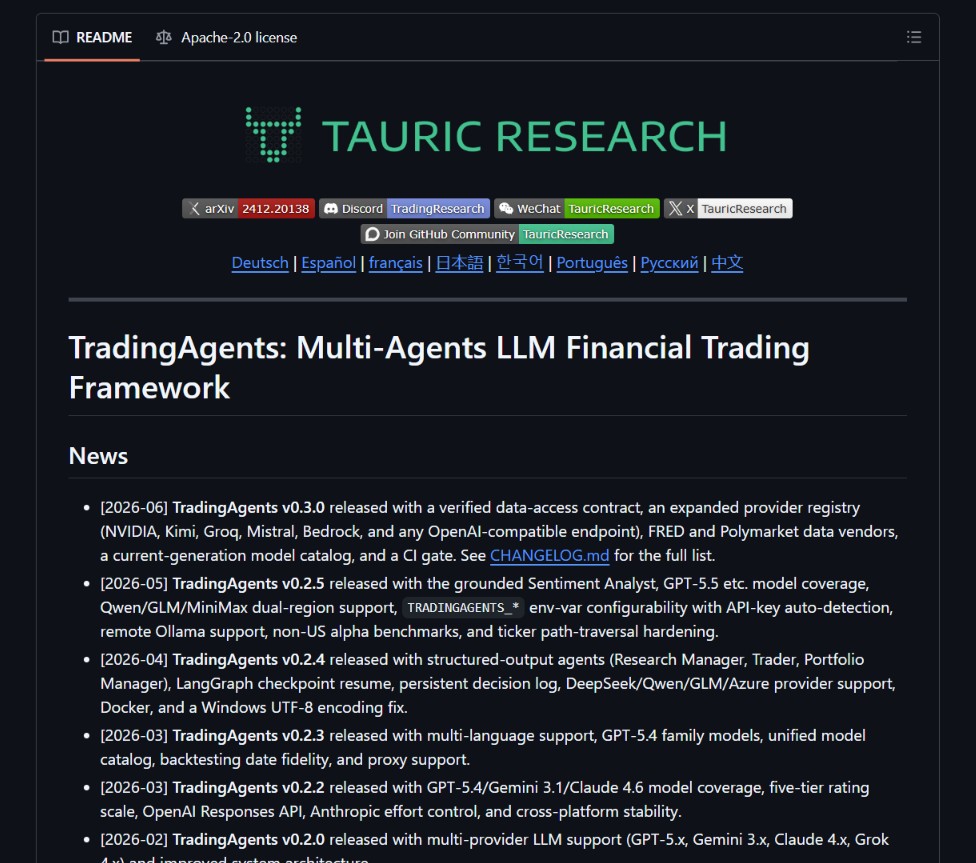
A research group going by Tauric Research just open sourced something the financial AI community has been waiting for, and the project is the first credible attempt to ship a full multi agent trading firm that anyone can run locally.
The repository is called TradingAgents, and it implements a complete AI trading organization with specialized analyst agents, a debate layer between bullish and bearish perspectives, and final decision routing that mirrors the structure of a real trading desk.
The framework supports stocks, crypto, and international markets, and it works with Claude, GPT, and Gemini as the underlying language model. The whole thing is 100 percent open source, which means you can audit the prompts, modify the agent roles, and run the system against your own data without paying a vendor.
This is not a chat wrapper around an API. It is a working multi agent system designed specifically for market analysis, and the design choices reflect real familiarity with how investment research actually gets done.
The Problem Most AI Trading Tools Leave on the Floor
The current state of AI in trading has a structural problem. Most tools fall into one of two camps, and both have gaps.
- Single Agent Wrappers: A chat model reads a ticker, summarizes a few headlines, and calls it analysis. The output sounds plausible but it has no internal structure, no adversarial review, and no separation between signal types
- Indicator Bots: Traditional technical analysis bots can run systematic strategies but they cannot read news, interpret sentiment, or reason about fundamentals, which is where most of the alpha actually comes from
TradingAgents closes both gaps by treating trading research as a multi disciplinary problem rather than a single prompt. The architecture is built around the same structure a real trading desk uses, and that structure is what produces better decisions.

What is Actually in the Repository
The repo implements the full pipeline of an AI trading firm, and each agent has a clearly defined role rather than a vague system prompt.
- Fundamental Analyst: Reads financial statements, earnings reports, and valuation data to produce a fundamental view on the asset
- Sentiment Analyst: Processes market sentiment signals from news flow, social media, and narrative shifts to gauge the crowd positioning
- News Analyst: Monitors macro and micro news catalysts that could move the price and ranks them by likely impact
- Technical Analyst: Runs traditional technical indicators and price action analysis on the chart data
- Bullish and Bearish Debate: Once the four analysts finish, a bullish agent and a bearish agent debate the conclusion. The debate layer is the most important design choice in the framework, because it forces the system to argue against its own initial conclusion before any decision is made
- Decision Routing: A final agent or routing layer produces the actionable output after weighing the debate, and the decision comes with the reasoning trail visible to the user
This is a real multi agent architecture, not a marketing term. Each agent has its own prompt, its own inputs, and its own output format, and the debate layer is the part most other AI trading tools skip.
Who This is for
The audience for TradingAgents is anyone who wants to think about markets with structured AI assistance rather than gut feel alone.
- Quantitative Traders: Quants who already build systematic strategies can use TradingAgents as a research layer for the qualitative signals that hard models miss
- Retail Investors: Individual investors who want a structured second opinion on a trade, with reasoning they can audit, will find the framework more useful than a generic chatbot
- AI Researchers: Multi agent AI researchers get a working reference implementation of a domain specific agent system, which is rare in 2026
- Developers: Engineers building trading tools, dashboards, or automation pipelines can fork the repo, swap in their own data sources, and customize the agent roles
- Educators and Students: Finance and AI courses can use TradingAgents as a teaching example of how to combine LLMs with structured reasoning in a high stakes domain
If you have ever wanted to run a trading desk without hiring a trading desk, this is the closest open source option available right now.
How the Debate Layer Changes the Output Quality
The most interesting design choice in TradingAgents is the adversarial debate between bullish and bearish agents before any decision is finalized. Most AI systems produce a single answer and stop. TradingAgents forces the system to argue against itself, and that adversarial pressure surfaces reasoning that a single agent would miss.
- A bullish narrative gets challenged on its weakest assumption
- A bearish narrative has to justify why the bullish case is wrong
- The final decision is closer to a balanced view than to either extreme
- The user can read the debate transcript and see exactly where the reasoning landed
This is closer to how a real investment committee works than how a chatbot works, and it is the design choice that makes TradingAgents feel like a firm rather than a tool.
Why This Repo Matters for the AI Trading Field
The bigger story is not the GitHub stars or the underlying models. It is what happens when a credible open source multi agent trading framework exists in the world.
- Open Source Beats Vendor Lock In: The financial AI space is full of paid products that hide their reasoning. TradingAgents ships the prompts, the architecture, and the data flow, so users own the system rather than renting it
- Multi Agent Is the Right Pattern for Trading: Trading is adversarial by nature. A system that argues with itself before deciding is more likely to catch bad calls than a system that produces a single confident answer
- Local Execution Matters: Running the system locally means your research, your portfolio, and your prompts stay on your machine, which matters for anyone who treats financial data as sensitive
- The Framework Is a Starting Point: The real value of the repo is that it gives the community a working starting point. Builders can fork it, specialize the agents, plug in proprietary data, and produce derivative systems for specific markets or strategies
Repo: https://github.com/TauricResearch
TradingAgents is the open source project that turns the phrase “AI trading firm” from a marketing slogan into an actual codebase, and that distinction matters more than it sounds. The repository is not a finished product, and it is not a guaranteed money making machine, but it is the most credible starting point for multi agent market analysis that exists in 2026.
Anyone who takes trading seriously and works with AI seriously should clone the repo, run it on a few tickers they already know, and read the debate transcripts. The output will not be perfect, but the architecture is the right one, and the right architecture is what separates an AI experiment from an AI product. Tauric Research shipped the foundation. The community decides what gets built on top of it.