Google Agent Development Kit (ADK) is an open-source framework for building always-on memory AI agents with Gemini 3.1 Flash‑Lite. This project enables persistent AI systems that run continuously as lightweight background processes. Unlike stateless agents that forget everything after each interaction, ADK agents maintain evolving memory over time. The framework eliminates complex infrastructure requirements while keeping operational costs negligible.
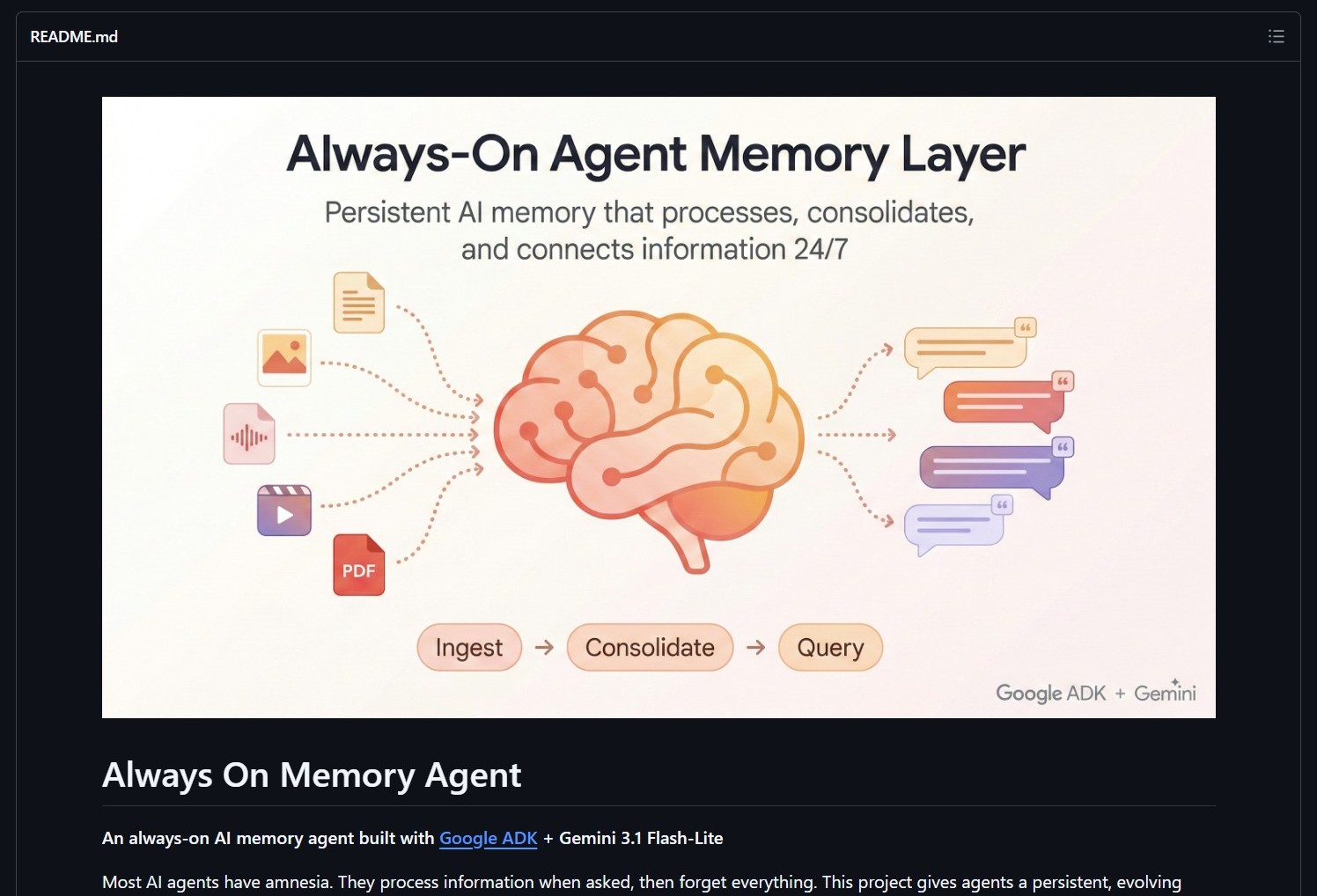
Google’s ADK solves the fundamental problem of agent amnesia in AI systems. Traditional AI agents process requests in isolation then discard all context. This project provides continuous memory that grows and consolidates information without vector databases or embeddings. The solution uses simple LLM-based memory reading, thinking, and writing structured memory.
Project Link
Project link:
https://github.com/GoogleCloudPlatform/generative-ai/tree/main/gemini/agents/always-on-memory-agent
How It Works: No Vector Databases, Just LLM Memory
The always-on memory agent works through three core components:
- Continuous Background Processing – Runs 24/7 as a lightweight process, constantly reading and updating memory
- Structured Memory System – LLM reads, thinks, and writes structured memory without vector embeddings
- Gemini 3.1 Flash‑Lite Integration – Uses Google’s efficient model for low-cost continuous operation
Unlike traditional approaches that require vector databases and complex embeddings, Google’s solution relies on the LLM itself to manage memory. This eliminates infrastructure complexity and reduces costs significantly. The agent continuously processes information, consolidates memories, and connects related concepts over time.

How to Deploy & Use Google ADK
- Clone the GitHub repository using the project link above
- Set up Google Cloud credentials and Gemini API access
- Configure the always-on memory agent with your specific use case
- Define memory retention policies and processing intervals
- Deploy as a background service on your preferred infrastructure
Deployment requires basic Python environment setup and Google Cloud authentication. The repository includes comprehensive examples for different memory agent configurations. Google documents production use cases handling thousands of continuous interactions daily.
The Verdict
Google’s Agent Development Kit represents a shift from stateless to stateful AI agents. By solving the memory problem without complex infrastructure, it makes persistent AI systems practical for real-world applications. The framework demonstrates that continuous AI operation can be both simple and cost-effective.
This approach complements other AI orchestration tools like Gstack which coordinates multiple AI personas for software development. Similarly, Claude Peers MCP enables real-time communication between Claude Code instances. Google ADK continues this trend by open-sourcing production-ready AI agent infrastructure.
- How to Build an MVP in 3 Hours with Vibe Coding Prompts
Badge Vibe Coding Prompt Template provides structured, copy-paste prompt templates that guide an idea through market research, a PRD, implementation..
- How to Build Safer Agents with Parlant Conversation Modeling
Badge Parlant promises to stop the “roll of the dice” approach by enforcing contextual guidelines that activate based on conversation..
- How to Build Interactive UIs for Agents with MCP Apps
Badge MCP Apps is an extension proposal, SEP-1865, that aims to standardize interactive user interfaces inside MCP hosts. The effort..
- How to Build AI Apps with Genkit and Firebase Studio
Badge Genkit is the open-source framework that powers Firebase Studio, and it provides SDKs for JS/TS, Go, and an alpha..
- How to Build a Local Multi-Agent Workforce with Eigent
Badge I ran into this project while evaluating desktop-first agent platforms that coordinate many workers in parallel. Eigent is a..
- How to Build RAG Apps with BRAG LangChain Notebooks
BRAG LangChain provides five notebooks that walk from basic RAG setups to advanced multi-query, routing, indexing, and reranking techniques. This..