

Vibe Coding Prompt Template provides structured, copy-paste prompt templates that guide an idea through market research, a PRD, implementation instructions for agents, and a working MVP in under three hours. Similar to how Activepieces exposes MCP servers for agent orchestration, this repo makes product development fast, reproducible, and accessible to non-technical creators.
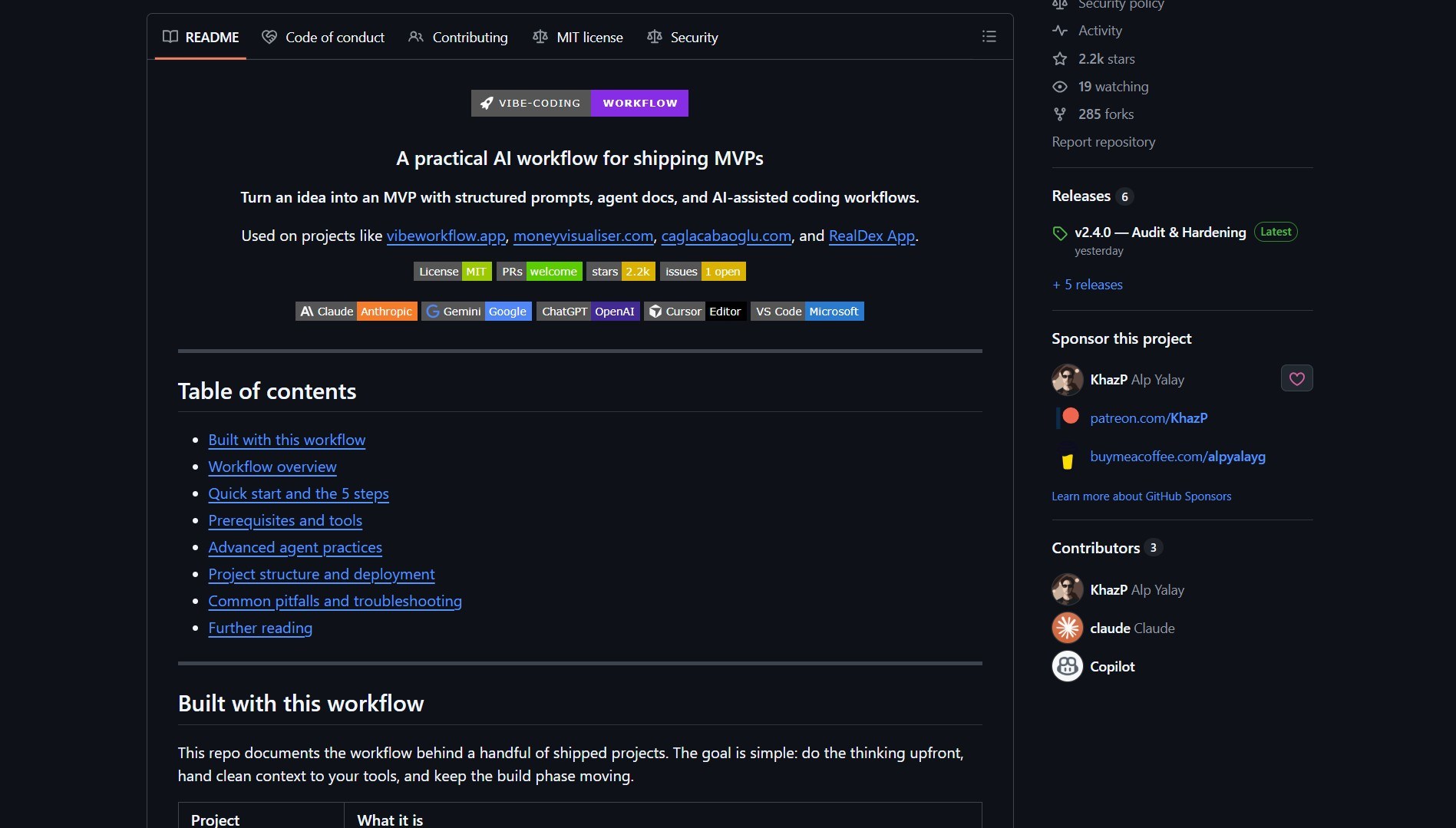
These templates are meant to be plugged directly into your favorite AI model or agent. They reduce guesswork, but you should validate outputs and iterate on prompts for your use case.
What it is
Vibe Coding Prompt Template is a collection of prompt patterns, scaffolds, and agent instructions that turn an idea into a working app quickly. While Hermes Agent turns the terminal into a persistent AI assistant, this repo bundles examples for market research, product requirement documents, developer instructions, and runnable agent steps to take you from concept to MVP.
How it works
At a high level, the workflow is:
- Run the market research prompt to gather target audience, competitors, and value props.
- Generate a concise PRD and acceptance criteria using the PRD prompt.
- Produce agent-ready implementation steps and prompt instructions that produce code, tests, and packaging for a minimal deployable artifact.
# quick start
git clone https://github.com/KhazP/vibe-coding-prompt-template.git
cd vibe-coding-prompt-template
# copy the prompts into your agent or model of choice and follow the README
| Feature | Why it matters |
|---|---|
| End-to-end prompts | From market research to deployable MVP, ready to paste into models |
| Non-technical friendly | Templates lower the barrier for creators without deep engineering skills |
| Agent-ready | Prompts structured for agent usage, including step by step tasks and checks |
| Fast iteration | Designed to produce usable artifacts quickly for validation |
Start with a narrow idea and run the full pipeline once to see where human edits are needed. Use the PRD output as the contract for agent generated code.
Pros and cons
Pros
- Fast route to validating ideas with minimal coding effort
- Reproducible prompt patterns make handoffs and collaboration easier
- Helpful for founders, product people, and creators who want a working prototype
Cons
- Prompts need tuning for different domains and languages
- Generated MVPs may require human polish and security review before real use
- Not a substitute for engineering when you need production reliability
Prompt driven pipelines can produce plausible but incorrect outputs. Validate market research claims and test generated code thoroughly before ship.
Project link
Here are what peoples are saying:
“bmad-method v6 has everything above and beyond” @vjatseslav_sergeevi4
“Nice! Goes from prompt engineering to context engineering” @gargi_gupta97
Quick commands and examples
# clone and inspect the templates
git clone https://github.com/KhazP/vibe-coding-prompt-template.git
ls vibe-coding-prompt-template
# try copying a market research prompt into your model and compare results
If you enjoy articles about top GitHub repositories like this, don’t forget to subscribe to Technolati.com.
- How to Build Safer Agents with Parlant Conversation Modeling
Badge Parlant promises to stop the “roll of the dice” approach by enforcing contextual guidelines that activate based on conversation..
- How to Build Interactive UIs for Agents with MCP Apps
Badge MCP Apps is an extension proposal, SEP-1865, that aims to standardize interactive user interfaces inside MCP hosts. The effort..
- How to Build AI Apps with Genkit and Firebase Studio
Badge Genkit is the open-source framework that powers Firebase Studio, and it provides SDKs for JS/TS, Go, and an alpha..
- How to Build a Local Multi-Agent Workforce with Eigent
Badge I ran into this project while evaluating desktop-first agent platforms that coordinate many workers in parallel. Eigent is a..
- How to Build RAG Apps with BRAG LangChain Notebooks
BRAG LangChain provides five notebooks that walk from basic RAG setups to advanced multi-query, routing, indexing, and reranking techniques. This..
- How to Build and Scale AI Agents with OpenHands Development Platform
OpenHands is a community-driven development platform for building and scaling AI agents. It provides a unified ecosystem that includes a..