

Lightpanda Browser is a headless browser written from scratch in Zig, built specifically for AI agents and automation workflows. It promises drop-in compatibility with Playwright and Puppeteer, while avoiding the heavyweight cost of full Chromium forks.
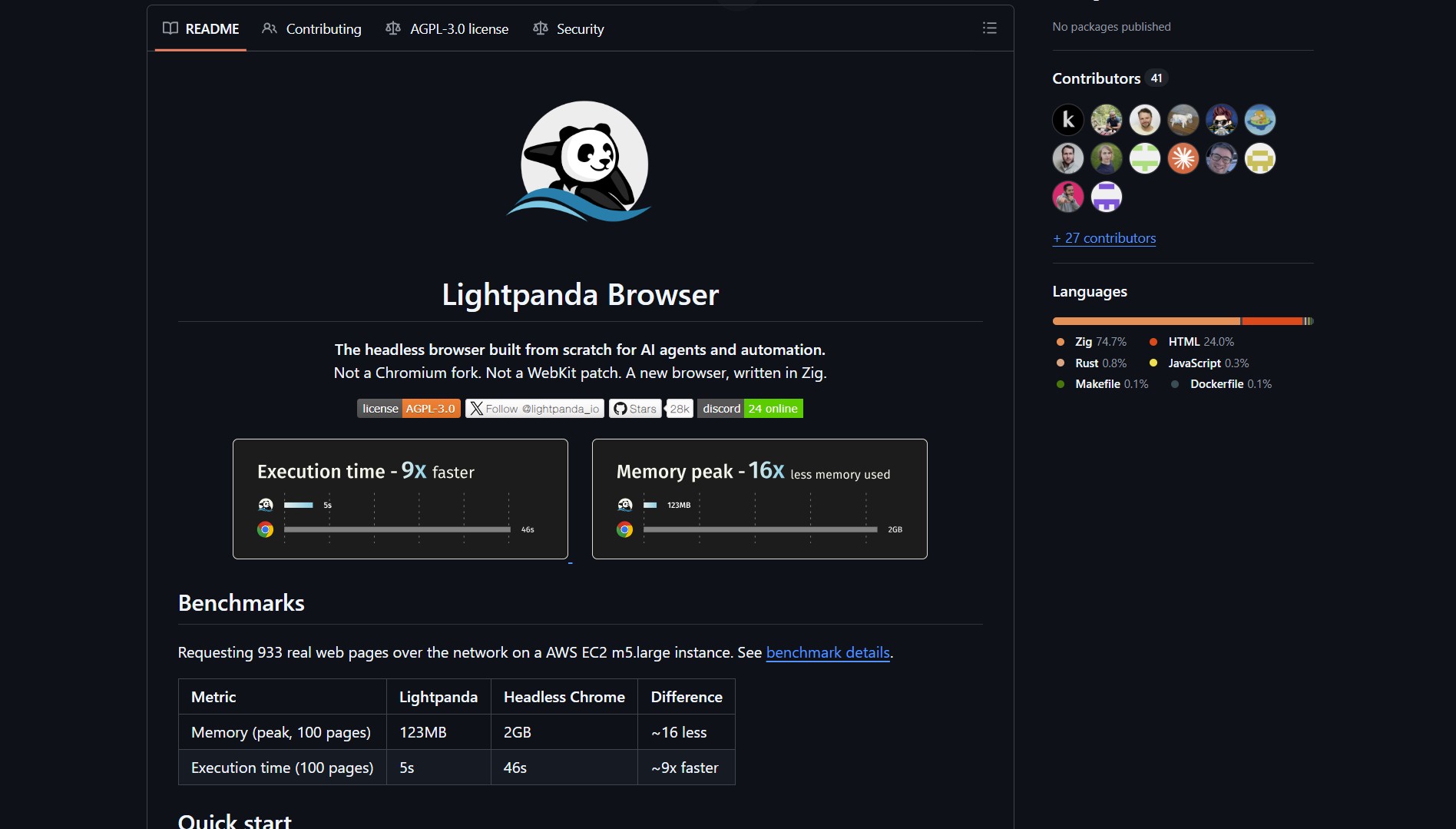
This is a developer focused project, aimed at agent builders and automation engineers who need a lightweight, fast runtime for scripted browsing. It is not a general purpose browser replacement.
What it is
Lightpanda Browser is a headless browser implementation, not a Chromium fork or WebKit patch. Written in Zig, it targets low overhead and high performance for automation tasks. The project claims zero changes required for Playwright or Puppeteer integrations, which makes it attractive for agents that need fast, repeatable browsing without the resource cost of full browser binaries. If you are assembling an agent stack for automated web scraping, a Scrapling integration pairs well with Lightpanda for lightweight, evasion-capable extraction.
How it works
At a high level, Lightpanda implements the automation protocol surface that agents and driver libraries expect, while minimizing the runtime and memory footprint. Because it is a new codebase, the project focuses on the plumbing that matters for automated flows, rather than shipping the entire browsing feature set. For a complete agent runtime that can drive this browser headlessly, Hermes Agent provides a persistent terminal interface for coordinating automation tasks.
# quick start
git clone https://github.com/lightpanda-io/browser.git
cd browser
# follow the README to build or use the Playwright/Puppeteer adapters
| Feature | Notes |
|---|---|
| Language | Implemented in Zig for performance and small binary size |
| Compatibility | Drop-in with Playwright and Puppeteer, no API changes required |
| Use case | Agentic automation, CI tasks, scraping and scripted workflows |
| Open source | MIT/OSS friendly, encourages experimentation |
Try Lightpanda on small, representative automation tasks first. Measure performance and compatibility with your Playwright or Puppeteer scripts before switching large pipelines.
Implementation notes
- The project replaces the heavyweight browser runtime with a purpose built headless implementation.
- Because it is new, some edge cases or web platform features may be missing; expect to validate your scripts against the runtime.
- Written in Zig, the codebase prioritizes minimal dependencies and fast startup.

New browser engines can be incomplete, and automation scripts that rely on subtle browser behaviors may need adjustment. Test in a sandbox and keep fallbacks to established runtimes during evaluation.
Try it locally
- Clone the repo and follow the build instructions on GitHub.
- Run a subset of your Playwright or Puppeteer tests against Lightpanda to verify compatibility and measure speed improvements.
Project link
Here are what peoples are saying:
“I’ve seen like 20 of these pop up over the past 2 weeks.” @dylanr_36
“kinda funny how for agent tools speed is basically distribution now. if it’s truly drop in, adoption should move fast” @mktpavlenko
“That sounds incredible! Can’t wait to see how it enhances AI capabilities. 🚀” @the_isaiah_dupree
Quick commands and examples
# clone and open the repo
git clone https://github.com/lightpanda-io/browser.git
ls browser
# follow the README for usage with Playwright or Puppeteer
If you enjoy articles about top GitHub repositories like this, don’t forget to subscribe to Technolati.com.
- Lightpanda: Fast Headless Browser for AI Agents
Lightpanda is a headless browser built from scratch in Zig for AI agents Someone just open-sourced a super fast headless..
- How to Use Velo as a Local-First Desktop Email Client
Velo is a blazing-fast, keyboard-first desktop email client with local SQLite storage Velo is a desktop Gmail client built with..
- How to Use PentAGI for Autonomous AI Red Teaming
PentAGI is an autonomous AI red team system that performs penetration testing with zero human input PentAGI is a fully..
- How to Use Dexter for Autonomous Financial Research
Dexter is an autonomous financial research agent that plans, executes, and validates its own investment analysis Dexter is an autonomous..
- How to Use PageIndex for Vectorless RAG on Complex Documents
Badge PageIndex argues that similarity is not the same as relevance, and it offers a vectorless, reasoning based approach to..
- How to Use OpenWork as a Desktop Interface for DeepAgents
Badge OpenWork is an opinionated desktop interface for deepagentsjs, it exposes filesystem planning, subagent delegation, and direct tool access so..